Substratos enzimáticos
Subcategorias de "Substratos enzimáticos"
Foram encontrados 1528 produtos de "Substratos enzimáticos"
2-Chloro-4-nitrophenyl a-D-maltotrioside
CAS:2-Chloro-4-nitrophenyl a-D-maltotrioside (2CNP) is a potent hypoglycemic agent that has been shown to decrease postprandial blood glucose levels in humans. 2CNP is a white crystalline solid that is soluble in water and ethanol. The transfer reactions of 2CNP are enhanced by benzalkonium chloride, which forms an organic complex with the drug. The optimum concentration for the hypoglycemic effect of 2CNP is determined to be 10 μM, which can be detected using an optical sensor. This compound also inhibits α-amylase and other enzymes involved in carbohydrate metabolism, leading to the accumulation of glycogen and lowering the blood glucose level.
Fórmula:C24H34CiNO18Pureza:Min. 95%Cor e Forma:Off-White Yellow PowderPeso molecular:659.98 g/molAldol® 458 nonanoate, Biosynth Patent: EP 2427431 and US 8940909
CAS:Produto ControladoAldol 458 nonanoate is a fluorogenic substrate that can be used in the detection of enzyme activity particularly C8/C9-esterases, lipases activity producing a yellow/green-orange color. Aldol 458 nonanoate reacts with enzymes, such as oxidoreductases and hydrolases, to produce light. This product is a conjugate of aldol 458 nonanoate and an enzyme substrate for the detection of these enzymes. It has been shown to be useful in food testing, staining, fluorogenic substrate, environmental testing, chromogenic substrate, conjugate, high purity, enzyme substrate for diagnostics and ligand.
Fórmula:C25H29NO4Pureza:Min. 95%Peso molecular:407.5 g/molL-Luciferin, potassium salt
CAS:L-Luciferin is an enzyme substrate that is used in the detection of bioluminescence. It is a fluorogenic substrate that can be used to detect the presence of glucose in urine. L-Luciferin is also a chemiluminescent substrate that can be used to detect ATP, which is required for cell metabolism. L-Luciferin has been shown to be stable at pH levels ranging from 2.5 to 9 and can be stored for up to 3 years when stored at 4°C with no light or oxygen exposure. This product has CAS No. 754978-59-1, indicating high purity and quality. L-Luciferin will not stain or react with other compounds, making it highly suitable for use as a conjugate in diagnostic tests or as a ligand in fluorescent staining reactions.Fórmula:C11H7KN2O3S2Pureza:Min. 98.0 Area-%Peso molecular:318.42 g/molLuc-Salmonella
Luc-Salmonella is a conjugate of the enzyme luciferase and the substrate 5-bromo-4-chloro-3-indolyl phosphate. Luc-Salmonella has been used for diagnostic purposes in the detection of bacteria in culture media, as well as in environmental and food testing. Luc-Salmonella can be used to detect Salmonella, which is a bacterium that can cause gastrointestinal disease. Luminescence is measured using a luminometer or fluorimeter with an excitation wavelength of 485 nm and emission wavelengths at 510 nm. Luminescence from Luc-Salmonella is typically measured after 1 hour incubation with bacterial cells.
Luc-Salmonella has been shown to have high purity and quality due to its unique composition of enzyme substrate. This product has been tested for contamination by sensitive assays such as chemiluminescence, bioluminescence, or fluorescence. The purity level of Luc-SalPureza:Min. 96 Area-%Ref: 3D-L-8281
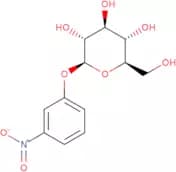
-Unit-mgmgA consultar5mgA consultar10mgA consultar25mgA consultar50mgA consultar100mgA consultar3-Nitrophenyl β-D-glucopyranoside
CAS:3-Nitrophenyl beta-D-glucopyranoside is a chromogenic enzyme substrate commonly used to assay for beta-glucosidase activity. Upon hydrolysis by the enzyme, it produces a yellow product that can be easily detected by spectrophotometry. This substrate is often used in the field of carbohydrate chemistry and biochemistry to study enzyme kinetics and inhibition in both in vitro and in vivo systems.Fórmula:C12H15NO8Pureza:Min. 95%Cor e Forma:White Yellow PowderPeso molecular:301.25 g/mol5-Bromo-4-chloro-3-indolyl-D-thymidine-3'-phosphate cyclohexylammonium salt
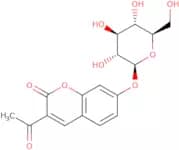
CAS:5-Bromo-4-chloro-3-indolyl-D-thymidine-3'-phosphate cyclohexylammonium salt is a chromogenic substrate used to detect the specific enzymatic activity of alkaline phosphatase. After cleavage, 5-bromo-4-chloro-indoxyl is released, resulting in a blue to blue-green color change in bacterial colonies or media. 5-Bromo-4-chloro-3-indolyl-D-thymidine-3'-phosphate cyclohexylammonium salt is used in immunohistochemistry (IHC) and Western blot detection, immunoassays used to detect proteins.Fórmula:C18H17BrClN3O8P·C6H14NPureza:Min. 95%Cor e Forma:White PowderPeso molecular:649.86 g/mol3-Acetylumbelliferyl b-D-glucopyranoside
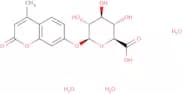
CAS:3-Acetylumbelliferyl beta-D-glucopyranoside is a fluorogenic enzyme substrate for beta-galactosidase-6-phosphatase. It is used in in diagnostic assays such as Gaucher disease.Fórmula:C17H18O9Pureza:Min. 95%Cor e Forma:PowderPeso molecular:366.32 g/mol4-Methylumbelliferyl b-D-glucuronide trihydrate
CAS:Fluorogenic substrate for beta-glucuronidase GUS
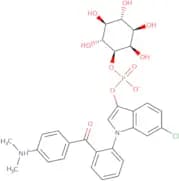
Fórmula:C16H22O12Pureza:Min. 98 Area-%Cor e Forma:White PowderPeso molecular:406.34 g/molAldol® 518 myo-inositol-1-phosphate - Biosynth Patent: EP 2427431 and US 8940909
CAS:Aldol® 518 myo-inositol-1-phosphate is a chromogenic and fluorogenic enzyme substrate used for detection of phosphatidyl-inositol specific phospholipase C activity (PI-PLC, EC 4.6.1.13). The colorless enzyme substrate is cleaved by PI-PLC or PI-PLC-positive microorganisms grown in liquid or solid media, yielding an intense red coloration. In combination with Aldol® 355 fluorescence enhancer, red fluorescence can also obtained. Aldol® 518 myo-inositol-1-phosphate is suitable for use in liquid and solid media, under aerobic as well as anaerobic conditions.Fórmula:C29H33ClN3O10PPureza:Min. 95 Area-%Cor e Forma:PowderPeso molecular:650.02 g/molFluorescein-dipalmitoylphosphatidylethanolamine triethylammonium salt
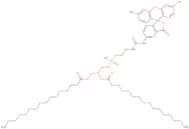
CAS:Fluorescein-dipalmitoylphosphatidylethanolamine triethylammonium salt is a fluorescent phospholipid derivative for phospholipase. This substrate consists of a fluorescein conjugated to DPPE (dipalmitoylphosphatidylethanolamine), a key component of biological membranes. This compound is frequently used in membrane dynamics studies and lipid metabolism research. The fluorescein moiety allows visualization of lipid interactions in model membranes, liposomes, or live-cell imaging applications. The triethylammonium salt form enhances solubility and stability, property that facilitates its use in aqueous and lipid-based environments.
Pureza:Min. 95%Cor e Forma:PowderPeso molecular:1,182.53 g/mol4-Methylumbelliferyl cholin phosphate
CAS:4-Methylumbelliferyl phosphocholine, commonly known as 4-MUPC, is a synthetic phosphodiester used as an enzyme substrate for phospholipase enzymes. 4-MUPC is used as a fluorogenic substrate to measure the activity of phopholipases, which are important mediators of cell signalling.Fórmula:C15H20NO6PPureza:Min. 99.0 Area-%Peso molecular:341.30 g/mol4-Methylumbelliferyl-N-acetyl-β-D-glucosaminide-6-sulfate, sodium salt
CAS:4-Methylumbelliferyl 2-acetamido-2-deoxy-beta-D-glucopyranoside-6-sulfate sodium salt is a high-quality fluorogenic substrate specifically designed for the detection and quantification of various enzymes, including beta-glucosidases and sulfatases. Upon hydrolysis by the target enzyme, this substrate releases the highly fluorescent 4-methylumbelliferone, allowing for real-time monitoring and accurate measurement of enzyme activities in biochemical assays, diagnostic tests, and research applications. 4-Methylumbelliferyl 2-acetamido-2-deoxy-beta-D-glucopyranoside-6-sulfate sodium salt has excellent solubility in water, ensuring a consistent and reliable performance in different experimental conditions. This versatile substrate is an essential tool for researchers and industry professionals who require a sensitive and reproducible detection method for enzymes of interest.Fórmula:C18H20NNaO11SPureza:Min. 98.0 Area-%Peso molecular:481.41 g/molRef: 3D-M-5505
-Unit-ggA consultar5mgA consultar25mgA consultar50mgA consultar100mgA consultar250mgA consultar3-Indoxyl phosphate p-toluidine Salt
CAS:Produto Controlado3-Indoxyl phosphate p-toluidine salt is a secretor of blood group A. It is used in the detection of the presence of alkaline phosphatase in serum and other body fluids. This compound has been shown to be an isoform of 3-indoxyl phosphate with a molecular mass of about 4,000 daltons. It is also used as a substrate for gel electrophoresis and filtration experiments. The purified form of this compound has been shown to have an alkaline phosphatase activity that is ˜4 times greater than that found in human serum and intestinal extracts.
Fórmula:C8H8NO4P·C7H9NPureza:Min. 98 Area-%Cor e Forma:PowderPeso molecular:320.28 g/molVargulin trifluoroacetate
CAS:Bioluminescent substrate for cypridina luciferase
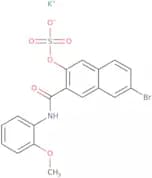
Fórmula:C22H27N7O·C2F3O2HPureza:Min. 95%Cor e Forma:Red PowderPeso molecular:519.52 g/molNaphthol AS-BI sulphate potassium
CAS:Naphthol AS-BI sulphate potassium salt is a modified naphtol AS substrate used for alkaline and acid phosphatase.Fórmula:C18H14BrNO6S•KPureza:Min. 95%Peso molecular:491.38 g/mol4-Methylumbelliferyl b-D-glucosaminide - Moscerdam™ biochemical purity
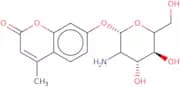
CAS:A substrate used for the diagnosis of Sanfilippo disease C (MPS III C).
Fórmula:C16H19NO7Pureza:Min. 98 Area-%Cor e Forma:White PowderPeso molecular:337.32 g/molAldol® 515 4-acetoxybutyrate solution, 0.75 M in DMSO, Biosynth Patent: EP 2427431 and US 8940909
CAS:Produto ControladoAldol® 515 4-acetoxybutyrate solution, 0.75 M in DMSO, is a chromogenic substrate that can be used to measure the activity of aldolase. It is a liquid at room temperature and has a pH of 7.2. The Aldol® 515 4-acetoxybutyrate solution, 0.75 M in DMSO, is soluble in water and organic solvents such as DMSO and ethanol. This product does not contain any preservatives or additives and is suitable for use with humans and animals. Aldol® 515 4-acetoxybutyrate solution, 0.75 M in DMSO, is manufactured by Cymit Quimica under patents EP 2427431 and US 8940909.br>br> Aldolase catalyzes the conversion of dihydroxyacetone phosphate (DHAP) to glyceraldehyde 3-phosphateFórmula:C29H28N2O5Pureza:Min. 95 Area-%Peso molecular:484.54 g/mol6-Chloro-4-(trifluoromethyl)umbelliferyl β-D-cellotrioside
6-Chloro-4-(trifluoromethyl)umbelliferyl b-D-cellotrioside is a fluorogenic substrate for cellulases and beta-glucosidases. After hydrolisis, the fluorophore TFMU is released generating a blue fluorescence.Fórmula:C28H34ClF3O18Pureza:Min. 95%Cor e Forma:White to off-white powder.Peso molecular:751.01 g/molCoelenterazine cp
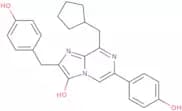
CAS:Coelenterazine cp is a coelenterazine analog for Renilla luciferase. In certain studies, it has been shown to be highly sensitive for the detection of human papilloma virus (HPV) and can be used in the diagnosis of cervical cancer.Fórmula:C25H25N3O3Pureza:Min. 95%Peso molecular:415.48 g/molNaphthol AS-BI N-acetyl-beta-D-glucosaminide
CAS:Naphthol AS-BI N-acetyl-beta-D-glucosaminide is a fluorogenic substrate for the pararosaniline-glyoxalase (PG) reaction. This substrate is used to study enzymatic activity in two human isoenzymes of PG, PG I and PG II. The conversion of this substrate by PG I or PG II results in a color change from yellow to red. Naphthol AS-BI N-acetyl-beta-D-glucosaminide may be used as an experimental tool to measure the activity of these enzymes and to study the effect of inhibitors on their activity. It can also be used as a marker for studying enzyme transfer between cells.Fórmula:C26H27BrN2O8Pureza:Min. 97.0 Area-%Peso molecular:575.42 g/mol