Substratos enzimáticos
Substratos enzimáticos são moléculas sobre as quais as enzimas atuam para catalisar reações químicas. O substrato liga-se ao sítio ativo da enzima, onde passa por uma transformação específica para formar o produto da reação. Os substratos enzimáticos são ferramentas essenciais na pesquisa para estudar a cinética enzimática, especificidade e mecanismo de ação. Eles também são usados em ensaios diagnósticos e estudos bioquímicos. Na CymitQuimica, oferecemos uma seleção diversificada de substratos enzimáticos de alta qualidade para apoiar suas pesquisas em enzimologia e bioquímica.
Subcategorias de "Substratos enzimáticos"
Foram encontrados 1525 produtos de "Substratos enzimáticos"
Ordenar por
Pureza (%)
0
100
|
0
|
50
|
90
|
95
|
100
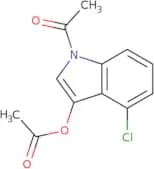
4-Chloro-3-Indoxyl-1,3-diacetate
CAS:4-Chloro-3-indoxyl-1,3-diacetate is a fluorogenic or chromogenic substrate used in food testing. It is also an enzyme substrate that can be used to detect the presence of bioluminescence. 4-Chloro-3-indoxyl-1,3-diacetate has been shown to have high purity and high quality for use in diagnostic kits. 4-Chloro-3-indoxyl-1,3-diacetate is a ligand that is conjugated with other molecules to form complexes for use in fluorescence and chemiluminescence experiments.Pureza:Min. 95%Peso molecular:251.67 g/molLuc-phosphate Na enhanced
Luc-phosphate Na enhanced is a bioluminescent substrate used to detect phosphatase activity in bacterial assays.
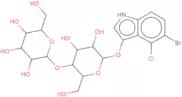
Fórmula:C18H12N2Na3O7PS2Pureza:Min. 97 Area-%Peso molecular:531.95 g/mol5-Bromo-4-chloro-3-indolyl a-D-maltopyranoside
CAS:5-Bromo-4-chloro-3-indolyl a-D-maltopyranoside is a chromogenic substrate used to detect the specific enzymatic activity of alpha-glucosidase. After cleavage, 5-bromo-4-chloro-indoxyl is released, resulting in a blue to blue-green color change in bacterial colonies or media. 5-Bromo-4-chloro-3-indolyl a-D-maltopyranoside is used in Pompe disease screening and glycogen storage disorder diagnosis.Fórmula:C20H25BrClNO11Pureza:Min. 95%Cor e Forma:PowderPeso molecular:570.77 g/mol4-Methylumbelliferyl-beta-D-glucopyranoside
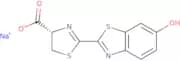
CAS:Fluorogenic substrate for beta-glucosidase yielding a blue fluorescent solution. Used for the detection of beta-glucosidase as an indicator of Enterococci.Fórmula:C16H18O8Pureza:Min. 99 Area-%Peso molecular:338.32 g/molD-Luciferin sodium salt
CAS:Bioluminescent substrate for luciferaseFórmula:C11H7N2NaO3S2Pureza:Min. 99 Area-%Cor e Forma:PowderPeso molecular:302.3 g/mol4-Trifluoromethylumbelliferyl-β-D-galactopyranoside
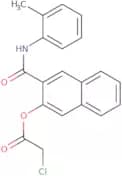
CAS:4-Trifluoromethylumbelliferyl-beta-D-galactopyranoside is a fluorogenic substrate for beta-galactosidase. It is used in the detection of beta-galactosidase activity in cell lysates and culture media, as well as in food testing. This compound has been shown to be highly pure, with a purity greater than 98%. 4-Trifluoromethylumbelliferyl-beta-D-galactopyranoside has also been shown to have high chemiluminescence, making it an ideal candidate for use in diagnostics.Fórmula:C16H15F3O8Peso molecular:392.29 g/molNaphthol AS-D chloroacetate
CAS:Histochemical substrate for esteraseFórmula:C20H16ClNO3Pureza:Min. 98 Area-%Cor e Forma:PowderPeso molecular:353.8 g/mol5-Bromo-4-chloro-3-indoxyl phosphate p-toluidine, micronized
CAS:A substrate for alkaline phosphatase yielding a blue insoluble product upon cleavage. Colour can be further enhanced when used together with Nitroblue tetrazolium. The substrate system is versatile and has functions in a variety of applications, including Northern, Southern, and Western blotting, in situ hybridization, ELISAs, microarray and immunohistochemistry. The micronized structure enhances solubility.Fórmula:C8H6BrClNO4P•C7H9NPureza:Min. 95%Cor e Forma:PowderPeso molecular:433.63 g/mol2-Chloro-4-nitrophenyl b-D-maltoside
2-Chloro-4-nitrophenyl b-D-maltoside is a fluorescent substrate used in diagnostic kits. It is used to detect the presence of beta-glucuronidase enzymes, which are found in many bacteria and fungi. 2-Chloro-4-nitrophenyl b-D-maltoside has been shown to be a superior substrate for beta-glucuronidase as it can be used at lower concentrations and is more stable than other substrates. The enzyme hydrolyzes the 2,4 nitrophenyl ester bond and releases the fluorogenic product 4-(2'-hydroxyethyl)benzene diazonium chloride (HED). This product emits light under ultraviolet light, making it ideal for use in Bioluminescence Assays.Pureza:Min. 95%Esculetin-7-β-D-galactopyranoside
Esculetin-7-beta-D-galactopyranoside, also known as 6,7-Dihydroxycoumaryl-7-beta-D-galactopyranoside, is a fluorogenic substrate used in the detection of beta-galactosidase activity. This coumarin derivative, when hydrolyzed, yields esculetin (6,7-dihydroxycoumarin) which, in the presence of iron salts, forms a brown-black complex.Fórmula:C15H16O9Pureza:Min. 95%Peso molecular:340.28 g/mol4-Methylumbelliferyl-β-L-fucopyranoside
CAS:4-Methylumbelliferyl-beta-L-fucopyranoside is a fluorogenic substrate that is used in food testing. It also has uses as a chromogenic substrate and a ligand for biological studies. 4-Methylumbelliferyl-beta-L-fucopyranoside is a conjugate of 4-methylumbelliferone and beta-D-fucopyranosyl ester, which is an enzyme substrate for the detection of phosphatases. This product can be used to detect the activity of phosphatase enzymes in various media, including culture media, environmental testing, and staining. 4MUFBPY also has chemiluminescent properties that can be used for bioluminescence assays.Fórmula:C16H18O7Peso molecular:322.31 g/molRef: 3D-M-5541
1gA consultar5gA consultar250mgA consultar500mgA consultar2500mgA consultar-Unit-ggA consultar4-Nitrophenyl O-(N-acetyl-a-neuraminosyl)-(2,3)-O-b-D-galactopyranosyl-(1,3)-2-acetamido-2-deoxy-a-D-galactopyran oxide
CAS:4-Nitrophenyl O-(N-acetyl-a-neuraminosyl)-(2,3)-O-b-D-galactopyranosyl-(1,3)-2-acetamido-2-deoxy-a-D-galactopyran oxide is a fluorogenic substrate that is used in the detection of glycosidases. It has been shown to be an excellent ligand for the enzyme beta galactosidase, which cleaves the glycan substrate 4NPOBGPA into 4NP and O-(N acetyl) neuraminic acid. 4NPOBGPA can be used as a chromogenic substrate for detecting beta galactosidase activity and can also be conjugated to other fluorescent molecules. This product is high purity and high quality.Pureza:Min. 95%Peso molecular:795.7 g/mol4-Methylumbelliferyl 2-acetamido-2-deoxy-a-D-glucopyranoside
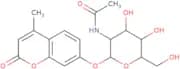
CAS:4-Methylumbelliferyl 2-acetamido-2-deoxy-alpha-D-glucopyranoside is a fluorogenic substrate for alpha-N-acetylglucosaminidase. After enzymatic cleaveage, free 4-methylumbelliferone (also known as hymecromone) is released, exhibiting blue fluorescence upon excitation with UV light. The strongest fluorescence of 4-methylumbelliferone requires deprotonation of the hydroxyl group (thus requires alkaline pH), with a maximal fluorescence intensity obtained with excitation at 350 to 370 nm and emission at 440 to 470 nm. The use of 4-methylumbelliferyl 2-acetamido-2-deoxy-alpha-D-glucopyranosideas a substrate for measuring the alpha-N-acetylglucosaminidase activity is used for Sanfilippo syndrome B screening and mucopolysaccharidosis diagnosis.Fórmula:C18H21NO8Pureza:Min. 98 Area-%Cor e Forma:PowderPeso molecular:379.36 g/mol4-Nitrocatechol sulfate dipotassium salt
CAS:Chromogenic sulfatase substrateFórmula:C6H3NO7SK2Pureza:Min. 98 Area-%Cor e Forma:PowderPeso molecular:311.35 g/mol3-(7-Hydroxycoumarin-3-carboxamido)propyl 4-O-(b-D-galactopyranosyl)-b-D-glucopyranoside
3-(7-Hydroxycoumarin-3-carboxamido)propyl 4-O-(b-D-galactopyranosyl)-b-D-glucopyranoside is a fluorogenic substrate that is used for the detection of beta-galactosidase. It has been shown to be an efficient substrate for the enzyme beta galactosidase and can be used to detect this enzyme in cell culture media and other diagnostic applications. 3-(7-Hydroxycoumarin-3-carboxamido)propyl 4-O-(b-D-galactopyranosyl)-b-D-glucopyranoside can also be used as a chromogenic substrate, which is added to a reaction mixture containing beta galactosidase, where it is hydrolyzed by the enzyme to produce a blue color. This product also has food testing and environmental testing applications.Pureza:Min. 95%4-Methylumbelliferyl b-D-galactopyranoside-6-sulphate sodium salt - Moscerdam™ biochemical purity
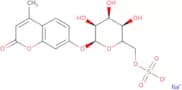
CAS:4-MU-Gal-6S (M4A) is a fluorogenic substrate of galactose-6-sulfate sulfatase (GALNS), used for the diagnosis of Mucopolysaccharidosis IV type A (MPS IV A). MPS IV, also known as Morquio syndrome, is a rare metabolic disorder in which the human body cannot process glycosaminoglycans (GAGs). MPS IV A is caused by the deficiency of the enzyme N-acetyl-galactosamine-6-sulfatase resulting in accumulation of keratan and chondroitin sulfate in tissues. M4A is used as the GALNS substrate in the anti-lysosomal enzyme antibody assay for the treatments of lysosomal storage disorders (LSDs) with enzyme replacement therapies (ERTs).Fórmula:C16H17NaO11SPureza:Min. 97 Area-%Cor e Forma:White PowderPeso molecular:440.36 g/mol4-Nitrophenyl 2-acetamido-4-O-(2-acetamido-2-deoxy-b-D-glucopyranosyl)-2-deoxy-a-D-galactopyranoside
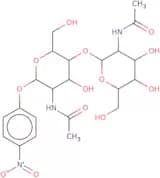
4-Nitrophenyl 2-acetamido-4-O-(2-acetamido-2-deoxy-b-D-glucopyranosyl)-2-deoxy-a-D-galactopyranoside is an enzyme substrate that is used in the detection of phenylalanine, tyrosine, and tryptophan. It is also used for environmental testing, bioluminescence, culture media, chemiluminescence, fluorogenic substrate, food testing, diagnostics and other applications.Pureza:Min. 95%Cor e Forma:Off-White PowderPeso molecular:545.49 g/mol1-Naphthyl β-D-galactopyranoside
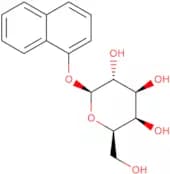
CAS:1-Naphthyl b-D-galactopyranoside is a chromogenic substrate used to detect the presence of beta-galactosidase enzymes. The enzyme cleaves the substrate to produce a colored product that can be quantified and visualized. This substrate is commonly used in applications such as the detection of lacZ gene expression in bacterial colonies or in histochemical staining of tissues to identify beta-galactosidase activity.Fórmula:C16H18O6Pureza:Min. 95%Cor e Forma:PowderPeso molecular:306.32 g/mol4-Methylumbelliferyl phosphate, free acid
CAS:A sensitive fluorogenic substrate for fluorometric and UV-spectrophotometric assays of phosphatases. It is used for the detection of C. perfringens because acid phosphatase is a highly specific indicator for C. perfringens.Fórmula:C10H9O6PPeso molecular:256.15 g/mol2-Nitrophenyl α-D-glucopyranoside
CAS:2-Nitrophenyl a-D-glucopyranoside is a chromogenic substrate commonly used to assay the activity of glucosidases. Upon cleavage of the glycosidic bond by glucosidases, the released 2-nitrophenyl group yields a yellow color detectable by spectrophotometry. This substrate has high sensitivity and is widely used in a variety of applications, including drug discovery and enzyme kinetics studies.
Fórmula:C12H15NO8Pureza:Min. 95%Cor e Forma:White to off-white solid.Peso molecular:301.25 g/mol