Substratos enzimáticos
Subcategorias de "Substratos enzimáticos"
Foram encontrados 1526 produtos de "Substratos enzimáticos"
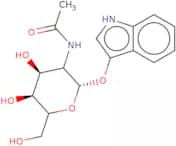
3-Indolyl 2-acetamido-2-deoxy-b-D-glucopyranoside
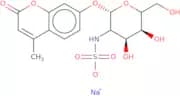
CAS:3-Indolyl 2-acetamido-2-deoxy-b-D-glucopyranoside is a substrate used for the detection of the enzyme N-acetylglucosaminidase (NAG). The enzyme hydrolyzes the NAG conjugate, releasing indole that can be detected through a colorimetric assay. This method is commonly used in clinical chemistry to evaluate kidney function, as NAG is excreted in urine and increased levels may indicate renal injury or disease. The indole NAG assay is also used in microbiology to detect the presence of NAG-producing bacteria.Pureza:Min. 95%Peso molecular:336.34 g/mol4-Methylumbelliferyl 2-deoxy-2-sulfamino-b-D-glucopyranoside sodium salt
4-Methylumbelliferyl 2-deoxy-2-sulfamino-beta-D-glucopyranoside sodium salt is a fluorogenic substrate for N-sulfoglucosamine sulfohydrolase. After enzymatic cleaveage, free 4-methylumbelliferone (also known as hymecromone) is released, exhibiting blue fluorescence upon excitation with UV light. The strongest fluorescence of 4-methylumbelliferone requires deprotonation of the hydroxyl group (thus requires alkaline pH), with a maximal fluorescence intensity obtained with excitation at 350 to 370 nm and emission at 440 to 470 nm. The use of 4-methylumbelliferyl 2-deoxy-2-sulfamino-beta-D-glucopyranoside sodium saltas a substrate for measuring the N-sulfoglucosamine sulfohydrolase activity is used for screening of Mucopolysaccharidosis IIIA (MPS IIIA) and diagnosis of Sanfilippo A syndrome.Fórmula:C16H19NO10SNaPureza:Min. 95%Cor e Forma:PowderPeso molecular:439.37 g/mol2-Nitrophenyl α-D-glucopyranoside
CAS:2-Nitrophenyl a-D-glucopyranoside is a chromogenic substrate commonly used to assay the activity of glucosidases. Upon cleavage of the glycosidic bond by glucosidases, the released 2-nitrophenyl group yields a yellow color detectable by spectrophotometry. This substrate has high sensitivity and is widely used in a variety of applications, including drug discovery and enzyme kinetics studies.
Fórmula:C12H15NO8Pureza:Min. 95%Cor e Forma:White to off-white solid.Peso molecular:301.25 g/mol4-Methylumbelliferyl-α-L-fucopyranoside
CAS:Fluorogenic substrate for α-L-Fucosidase yielding a blue fluorescent solution upon cleavage.
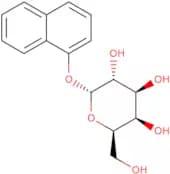
Fórmula:C16H18O7Peso molecular:322.32 g/mol1-Naphthyl a-D-galactopyranoside
CAS:1-Naphthyl a-D-galactopyranoside is a chromogenic substrate use to detect alpha-galactosidase activity.Fórmula:C16H18O6Pureza:Min. 95%Cor e Forma:PowderPeso molecular:306.31 g/molNaphthol AS-BI β-L-fucopyranoside
CAS:Substrate for the detection of beta-D-fucosidaseFórmula:C24H24BrNO7Pureza:Min. 95%Peso molecular:518.35 g/mol4-Methylumbelliferyl phosphate, free acid
CAS:A sensitive fluorogenic substrate for fluorometric and UV-spectrophotometric assays of phosphatases. It is used for the detection of C. perfringens because acid phosphatase is a highly specific indicator for C. perfringens.
Fórmula:C10H9O6PPeso molecular:256.15 g/molRef: 3D-M-5801
10gA consultar25gA consultar50gA consultar100gA consultar250gA consultar-Unit-ggA consultar2-Naphthyl b-D-galactopyranoside
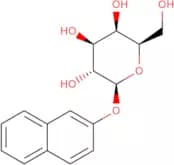
CAS:2-Naphthyl beta-D-galactopyranoside is a glycoside that is found in the flowers of the plant Eschscholzia californica. It is used as a localizer for bacterial strains and can be hydrolyzed by enzymes to release naphthalene. 2-Naphthyl beta-D-galactopyranoside has been shown to inhibit the growth of corynebacterium and diazonium salt, which may be due to its ability to bind to DNA and disrupt protein synthesis. The potential use of this molecule is for its insolubility, which prevents it from being absorbed by skin cells.
Fórmula:C16H18O6Pureza:Min. 99 Area-%Cor e Forma:PowderPeso molecular:306.31 g/molL-Pro-PAB-Resorufin
L-Pro-PAB-Resorufin is a highly sensitive chromogenic and fluorogenic indicator for L-proline aminopeptidase activity and related enzymes occurring in prokaryotic as well as eukaryotic organisms. After removal of the L-proline amide substructure by enzymatic hydrolysis and spontaneous elimination of the para-amino-benzyl (PAB) spacer, the initially orange colored compound yields an intense pink color. In addition, the released chromophor is an excellent fluorophor showing red fluorescence at an emission wavelength of 580 to 600 nm when excited at 560 to 570 nm.
Fórmula:C24H21N3O4Pureza:Min. 70 Area-%Cor e Forma:PowderPeso molecular:415 g/mol4-Methylumbelliferyl palmitate
CAS:4-Methylumbelliferyl palmitate, commonly names as 4-MUP, is a fluorescent probe that binds to lipases, enzymes responsible to assist on the hydrolysis of fats. In diagnosis, 4-MUP is used for screening of lysosomal storage diseases (LSD) caused by a deficiency of a single enzyme involved in the metabolism of glycoproteins, lipids or mucopolysaccharides.
Fórmula:C26H38O4Pureza:Min. 95%Cor e Forma:White PowderPeso molecular:414.58 g/molAldol® 484 alpha-D-glucopyranoside, Biosynth Patent: EP 2427431 and US 8940909
CAS:Aldol® 484 alpha-D-glucopyranoside is a chromogenic and fluorogenic enzyme substrate for alpha-glucosidase activity (EC 3.2.1.20, alpha-1,4-glucosidase, also known as maltase). The colorless enzyme substrate is cleaved by bacteria producing this enzyme in liquid or solid media, yielding orange color. Green fluorescence is also generated if a suitable matrix is present such as: cellulose acetate filters, polypropylene tubes or microplates and polyethylene vials. Aldol® 484 alpha-D-glucopyranoside can be used under aerobic and anaerobic conditions.
Fórmula:C26H24ClFN2O7Pureza:Min. 95%Cor e Forma:PowderPeso molecular:530.93 g/molN,N,N',N'-Tetramethyl-p-phenylenediamine dihydrochloride
CAS:Reducing co-substrate for heme peroxidases; test reagent in microbiologyFórmula:C10H16N2·2HClPureza:Min. 95%Cor e Forma:White PowderPeso molecular:237.17 g/mol6-Hexadecanoylamino-4-methylumbelliferone
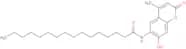
CAS:Fluorochrome for calibration of fluorimeters. Used with corresponding fluorogenic substrates for the diagnosis of Krabbe - and Niemann-Pick A/B disease.Fórmula:C26H39NO4Pureza:Min. 95%Cor e Forma:White PowderPeso molecular:429.59 g/molIPTG - non animal origin
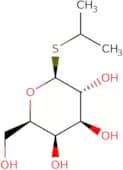
CAS:Isopropyl-beta-D-thiogalactopyranoside (IPTG) is a non-metabolizable allolactose analogue, widely used in molecular biology for overexpression of recombinant proteins from inducible systems under the control of lac promoter. IPTG binds to the LacI repressor and causes its release from the lac operator, allowing gene expression of lac operon to take place. IPTG is present in vectors of pGEX, pGEM-T, pET, pRSET, pMAL class and others.Fórmula:C9H18O5SPureza:Min. 99 Area-%Cor e Forma:White PowderPeso molecular:238.3 g/mol4-Methylumbelliferyl-alpha-L-rhamnopyranoside
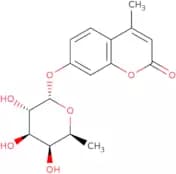
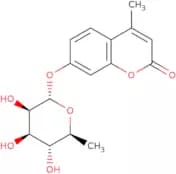
CAS:4-Methylumbelliferyl-alpha-L-rhamnopyranoside is a fluorogenic substrate for alpha-L-rhamnosidase. After enzymatic cleaveage, free 4-methylumbelliferone (also known as hymecromone) is released, exhibiting blue fluorescence upon excitation with UV light. The strongest fluorescence of 4-methylumbelliferone requires deprotonation of the hydroxyl group (thus requires alkaline pH), with a maximal fluorescence intensity obtained with excitation at 350 to 370 nm and emission at 440 to 470 nm. The use of 4-methylumbelliferyl-alpha-L-rhamnopyranosideas a substrate for measuring the alpha-L-rhamnosidase activity is used for detection of bacterial infection.Fórmula:C16H18O7Pureza:Min. 98 Area-%Cor e Forma:PowderPeso molecular:322.32 g/mol4-Nitrophenyl-alpha-D-galactopyranoside
CAS:Chromogenic substrate yielding a soluble chromophore for the colorimetric assay of α-D-galactosidase upon cleavage. Used for the detection of hydrolases in tissues and membranes.Fórmula:C12H15NO8Pureza:Min. 99.0 Area-%Peso molecular:301.26 g/mol1-Naphthyl β-D-mannopyranoside
CAS:1-Naphthyl β-D-mannopyranoside is a chromogenic (also fluorogenic) substrate. After cleavage, 1-naphthol is released and is used to quantify beta-mannosidase activity.Fórmula:C16H18O6Pureza:Min. 95%Cor e Forma:PowderPeso molecular:306.31 g/mol4-Methylumbelliferyl phosphate, bis(2-amino-2-methyl-1,3-propanediol) salt
CAS:Sensitive fluorogenic substrate for fluorometric and UV-spectrophotometric assays of phosphatases.Fórmula:C18H31N2O10PPureza:Min. 98.0 Area-%Peso molecular:466.43 g/mol4-Methylumbelliferyl a-L-idopyranosiduronic acid sodium salt
CAS:PAIRED PRODUCT AVAILABLE: alpha-L-iduronidase Enzyme, FI179383.
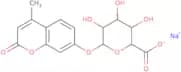
4MU-alpha-L-idopyranosiduronic acid is a fluorogenic substrate for alpha-L-iduronidase. Active alpha-L-iduronidase cleaves the MU moiety from the synthetic substrate, which results in release of a fluorescent signal (Ex 360 nm / Em 455 nm). The reaction is stopped by the addition of sodium carbonate. 4MU-alpha-L-idopyranosiduronic acid is used in alpha-L-iduronidase assays in the context of biochemical characterisation of samples from patients affected by lysosomal storage disease mucopolysaccharidosis I (MPS I).Fórmula:C16H15NaO9Pureza:Min. 98 Area-%Cor e Forma:White PowderPeso molecular:374.27 g/molLuc-Salmonella
Luc-Salmonella is a bioluminescent substrate for bacterial luciferase use to detect Salmonella.
Pureza:Min. 95%Cor e Forma:Powder