Substratos enzimáticos
Substratos enzimáticos são moléculas sobre as quais as enzimas atuam para catalisar reações químicas. O substrato liga-se ao sítio ativo da enzima, onde passa por uma transformação específica para formar o produto da reação. Os substratos enzimáticos são ferramentas essenciais na pesquisa para estudar a cinética enzimática, especificidade e mecanismo de ação. Eles também são usados em ensaios diagnósticos e estudos bioquímicos. Na CymitQuimica, oferecemos uma seleção diversificada de substratos enzimáticos de alta qualidade para apoiar suas pesquisas em enzimologia e bioquímica.
Subcategorias de "Substratos enzimáticos"
Foram encontrados 1529 produtos de "Substratos enzimáticos"
Ordenar por
Pureza (%)
0
100
|
0
|
50
|
90
|
95
|
100
2-Nitrophenyl 2-acetamido-2-deoxy-b-D-galactopyranoside
CAS:<p>2-Nitrophenyl 2-acetamido-2-deoxy-b-D-galactopyranoside is a carboxymethyl derivative of the natural substrate of β-galactosidase, which is used as a substrate for the production of recombinant proteins in the corynebacterium glutamicum. The enzyme β-galactosidase hydrolyzes this substrate to produce an acid molecule and a sugar molecule. This product can be used in biotechnological processes for the production of recombinant proteins or other bioactive molecules. It can also be used in the isolation of nucleic acid from bacteria or fungi, or to study bacterial membrane transport systems. 2NPGAG can be expressed as a recombinant protein with expression vectors such as pET21a and pET24a. It has been shown that this product inhibits transport through membranes by binding to cellulose, which may be useful for studies on cellulose biosynthesis</p>Pureza:Min. 95%Peso molecular:342.3 g/mol3-Indolyl b-D-cellotetraoside
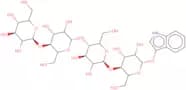
3-Indolyl b-D-cellotetraoside is a chemiluminescent substrate that is used as an indicator in the detection of aminoglycosides. The ligand is a cell wall component that has been shown to bind specifically to the active site of bacterial β-lactamases, which are enzymes that catalyze the hydrolysis of β-lactam antibiotics. 3-Indolyl b-D-cellotetraoside can be used for bacterial identification and enumeration, food testing, and enzyme substrate for diagnostics. It fluoresces in response to electron excitation with a wavelength of about 590 nm.Pureza:Min. 95%Peso molecular:781.71 g/mol4-Nitrophenyl phosphate bis(tris) salt
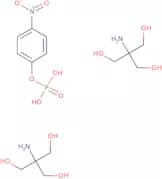
CAS:<p>Substrate for alkaline phosphatase</p>Fórmula:C6H6NO6P•(C4H11NO3)2Pureza:(%) Min. 99%Cor e Forma:PowderPeso molecular:461.36 g/mol4-Nitrophenyl 2-O-(a-D-glucopyranosyl)-a-D-glucopyranoside
CAS:<p>4-Nitrophenyl 2-O-(α-D-glucopyranosyl)-α-D-glucopyranoside is a specialized chromogenic pNP substrate featuring dual glucose-linked moieties, designed for accurate detection and quantification of specific glycosidase enzymes. Upon cleavage by target enzymes, this substrate releases 4-Nitrophenol, which can be easily monitored spectrophotometrically as a yellow color change. This advanced substrate offers enhanced specificity and sensitivity in enzyme assays, facilitating cutting-edge research in biochemistry, enzymology, and other related fields.</p>Pureza:Min. 95%Peso molecular:463.39 g/mol2-Nitrophenyl 2,3,4-tri-O-acetyl-b-D-glucuronide methyl ester
CAS:<p>2-Nitrophenyl-2,3,4-tri-O-acetyl-b-D-glucuronide methyl ester is a tri-O-acetylated glucuronide substrate commonly used in chromogenic assays to detect the activity of beta-glucuronidase. Upon hydrolysis by the enzyme, the substrate releases 2-nitrophenol, which can be spectrophotometrically. The substrate is widely used in diagnostic tests to assess bacterial and fungal infections, as well as in drug metabolism studies.</p>Pureza:Min. 95%Peso molecular:455.37 g/mol4-Methylumbelliferyl 4,6-O-benzylidene-b-D-galactopyranoside
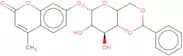
<p>4-Methylumbelliferyl 4,6-O-benzylidene-b-D-galactopyranoside is a fluorogenic substrate that is used in the detection of galactosidases. It has been shown to be a potent inhibitor of these enzymes and can be used to study the activity of various galactosidases. This substrate is used in the measurement of carbohydrate metabolism, including glycolysis and glycogenolysis. 4-Methylumbelliferyl 4,6-O-benzylidene-b-D-galactopyranoside has been shown to produce chemiluminescence when reacted with horseradish peroxidase and hydrogen peroxide. It also produces bioluminescence when exposed to luciferase and adenosine triphosphate (ATP).</p>Pureza:Min. 95%Peso molecular:426.42 g/mol4-Nitrophenyl 2-acetamido-2-deoxy-6-O-trityl-b-D-glucopyranoside
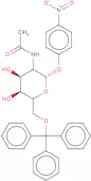
<p>4-Nitrophenyl 2-acetamido-2-deoxy-6-O-trityl-b-D-glucopyranoside offers unmatched versatility as a chromogenic pNP substrate for detecting b-D-glucopyranosidase activity. The substrate is specifically designed to produce a yellow 4-nitrophenol product upon enzyme hydrolysis, which can be measured using absorbance spectroscopy. The unique tritylated glucopyranoside group ensures improved compound stability and selectivity while providing ease of handling. This versatile substrate is ideal for a broad range of biochemical, research, and diagnostic applications.</p>Pureza:Min. 95%Peso molecular:584.62 g/mol4-Nitrophenyl 4,6-O-benzylidene-a-D-mannopyranoside
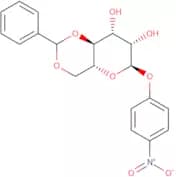
CAS:<p>4-Nitrophenyl 4,6-O-benzylidene-a-D-mannopyranoside is a chromogenic substrate for alpha-mannosidase and beta-glucosidase. It is used as a diagnostic tool for identifying the presence of these enzymes in certain bacteria. This product is also used in food testing, environmental testing, and bioluminescence.</p>Pureza:Min. 95%Peso molecular:389.36 g/molAldol® 479 acetate, Biosynth Patent: EP 2427431 and US 8940909
CAS:Produto Controlado<p>Aldol acetate is a chromogenic substrate that is used in food testing and diagnostics. Aldol acetate can be used in the detection of aminopeptidase and dipeptidyl peptidase activities, as well as in the determination of urinary proteins. Aldol acetate can also be used to detect anaerobic bacteria. This compound is conjugated with various ligands for use in immunoassays, such as beta-galactosidase, beta-glucuronidase, alpha-naphthyl phosphate ester, and phenyl phosphate ester. This product has been shown to be useful for chemiluminescent assays of DNA polymerases and reverse transcriptases in environmental samples. It has also been shown to be useful for bioluminescent assays of DNA polymerases and reverse transcriptases in environmental samples.</p>Fórmula:C25H22N2O3Pureza:Min. 95.0 Area-%Peso molecular:398.45 g/mol1-Naphthyl 2-acetamido-2-deoxy-b-D-galactopyranoside
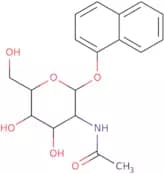
CAS:<p>1-Naphthyl 2-acetamido-2-deoxy-b-D-galactopyranoside (1NADG) is a fluorogenic substrate that reacts with an enzyme to produce light. It is used in diagnostic tests for the detection of bacteria, and can be used as a chromogenic substrate in biochemical assays. 1NADG has also been shown to be useful in staining bacterial cells grown on agar plates. Additionally, this compound is used as a bioluminescent probe for detecting bacteria with luciferase activity.<br>br>br></p>Pureza:Min. 95%Peso molecular:347.4 g/molAldol® 491 acetate, Biosynth Patent: EP 2427431 and US 8940909
CAS:Aldol 491 acetate is a food and environmental testing chemical, which can be used for the detection of bacteria. Aldol 491 acetate provides a chromogenic substrate for the detection of enzymes and can be used as a substrate in enzyme-linked immunosorbent assay (ELISA) procedures. Aldol 491 acetate also has chemiluminescent properties and can be used as a fluorogenic substrate.Fórmula:C22H17NO4Pureza:Min. 95 Area-%Peso molecular:359.37 g/mol2-Nitrophenyl 2,2',3,3',4'-penta-O-acetyl-b-D-xylobioside
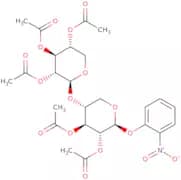
CAS:<p>2-Nitrophenyl 2,2',3,3',4'-penta-O-acetyl-b-D-xylobioside is an oligosaccharide that is used as a substrate for the transport of nucleic acid molecules. It can be used to study the function of membrane transport proteins and their homologues. This compound has been shown to inhibit the growth of corynebacterium glutamicum and trisaccharide emissions.</p>Pureza:Min. 95%Peso molecular:613.52 g/mol4-Nitrophenyl 2-acetamido-3,6-di-O-acetyl-4-O-[2-O-(2,3,4-tri-O-benzoyl-a-L-fucopyranosyl)-3,4,6-tri-O-acetyl-b-D-galactopyranosyl]- 2-deoxy-b-D-glucopyranoside
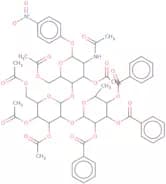
<p>This chemical is a ligand that can bind to the enzyme luciferase. In a bioluminescence reaction, this chemical reacts with oxygen and ATP to produce light. This product has been tested for purity and quality and is suitable for use in culture media, environmental testing, or diagnostics. It has also been shown to be an excellent fluorescent substrate for fluorogenic or chromogenic substrates in enzyme substrate assays.</p>Pureza:Min. 95%Peso molecular:1,173.08 g/mol4-Methylumbelliferyl 2,3,4-tri-O-benzoyl-b-D-galactopyranoside-6-sulfate
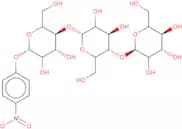
<p>4-Methylumbelliferyl 2,3,4-tri-O-benzoyl-b-D-galactopyranoside-6-sulfate is a fluorogenic substrate for β-galactosidase and a chromogenic substrate for β-glucuronidase. It is used in food testing, environmental testing, and diagnostics.</p>Pureza:Min. 95%Peso molecular:730.69 g/mol4-Nitrophenyl β-D-maltotrioside
CAS:<p>Chromogenic substrate targeting amylase</p>Fórmula:C24H35NO18Pureza:Min. 95%Cor e Forma:PowderPeso molecular:625.53 g/mol4-Nitrophenyl 2,3,4,6-tetra-O-acetyl-b-D-thiogalactopyranoside
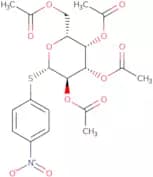
CAS:<p>4-Nitrophenyl 2,3,4,6-tetra-O-acetyl-b-D-thiogalactopyranoside (NPG) is a fluorogenic substrate that can be used in the detection of beta-galactosidase activity. It reacts with 4-nitrophenol to form an orange product at pH 6.0. The fluorescence intensity increases with increasing concentrations of the substrate and enzyme. The reaction is inhibited by borax, which competes for the enzyme active site. This product has been used as a chromogenic substrate for beta-galactosidase and as an enzyme substrate for beta-galactosidase in diagnostic tests for galactosemia and other carbohydrate metabolism disorders. NPG has also been used in chemiluminescent assays to detect beta-galactosidase activity in culture media and as a bioluminescence substrate in the detection of bacterial</p>Pureza:Min. 95%Peso molecular:485.47 g/molNaphthol AS-BI b-D-glucopyranoside
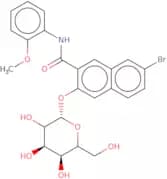
CAS:<p>Naphthol AS-BI b-D-glucopyranoside is a substrate for enzymes such as β-glucosidase and β-glycosidase. It has been used in diagnostic tests to detect the presence of amylase, lipase, α-amylase, or maltase in urine and feces. In biochemistry, naphthol AS-BI b-D-glucopyranoside is often used as a chromogenic or fluorogenic substrate for the detection of β-galactosidases and other glycosidases. This product has also been used in the detection of bacteria in culture media. Naphthol AS-BI b-D-glucopyranoside is a high quality reagent that can be used for chemiluminescence experiments, food testing, and environmental testing.</p>Pureza:Min. 95%Peso molecular:534.35 g/molAldol® 518 β-D-cellobioside, Biosynth Patent: EP 2427431 and US 8940909
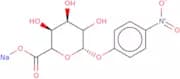
CAS:<p>Aldol® 518 beta-D-cellobioside is a chromogenic substrate for the detection of glycosidases. Aldol® 518 beta-D-cellobioside reacts with enzymes such as alpha-amylase, beta-galactosidase, and alpha-glucosidase to produce a fluorescent product. This product is detected by spectrophotometer, fluorometer, or luminometer. The fluorescence intensity is proportional to the concentration of the enzyme in the sample.<br>It has been shown that Aldol® 518 beta-D-cellobioside can be used as a substitute for conventional substrates in food testing and diagnostics, such as staining and culture media. It also has applications in environmental testing and enzyme substrate assays.</p>Fórmula:C35H39ClN2O12Pureza:Min. 95 Area-%Peso molecular:715.15 g/mol4-Nitrophenyl b-D-glucuronide sodium salt
CAS:<p>4-Nitrophenyl b-D-glucuronide sodium salt is a high-quality chromogenic substrate specifically designed for the colorimetric detection and measurement of β-glucuronidase activity. Upon enzymatic cleavage, it releases the yellow 4-nitrophenol, enabling quantitative analysis via spectroscopy. This compound is conveniently provided as a sodium salt to ensure enhanced solubility, stability, and shelf life. It is an ideal choice for biochemical, research, and diagnostic applications requiring a reliable and efficient b-D-glucuronide substrate.</p>Pureza:Min. 95%Peso molecular:337.21 g/mol4-Methylumbelliferyl 3,4,6-tri-O-acetyl-2-deoxy-2-trifluoroacetamido-a-D-glucopyranoside
CAS:<p>4-Methylumbelliferyl 3,4,6-tri-O-acetyl-2-deoxy-2-trifluoroacetamido-a-D-glucopyranoside (4MUAA) is a fluorescent dye that is used for the detection of envelopment in cells. This dye binds to cell membranes and can be detected with a fluorescence microscope. 4MUAA can be used to determine the efficiency of an experimental methodology or algorithm by measuring the change in fluorescence intensity as a result of experimental treatment. The use of 4MUAA has been shown to be effective in determining whether or not there is an association between nationwide environmental pollution and cancer rates in Japan.</p>Pureza:Min. 95%Peso molecular:559.44 g/mol