Substratos enzimáticos
Substratos enzimáticos são moléculas sobre as quais as enzimas atuam para catalisar reações químicas. O substrato liga-se ao sítio ativo da enzima, onde passa por uma transformação específica para formar o produto da reação. Os substratos enzimáticos são ferramentas essenciais na pesquisa para estudar a cinética enzimática, especificidade e mecanismo de ação. Eles também são usados em ensaios diagnósticos e estudos bioquímicos. Na CymitQuimica, oferecemos uma seleção diversificada de substratos enzimáticos de alta qualidade para apoiar suas pesquisas em enzimologia e bioquímica.
Subcategorias de "Substratos enzimáticos"
Foram encontrados 1528 produtos de "Substratos enzimáticos"
Ordenar por
Pureza (%)
0
100
|
0
|
50
|
90
|
95
|
100
5-Bromo-3-indoxyl-β-D-galactopyranoside-6-sulfate sodium salt
CAS:<p>5-Bromo-3-indoxyl-beta-D-galactopyranoside (5BIG) is a fluorogenic substrate that has been shown to be an effective enzyme substrate. It is used in the chemiluminescence, bioluminescence, and fluorescence detection of enzymes. 5BIG is also a chromogenic substrate for nucleic acid staining and can be used in food testing as well as diagnostics. 5BIG is highly pure and high quality with a CAS number of 1301706-59-1.</p>Fórmula:C14H15BrNNaO9SPureza:Min. 98 Area-%Peso molecular:476.24 g/molCesium carbonate
CAS:<p>Cesium carbonate is a compound that has various applications in different fields. It is commonly used as an aldehyde scavenger in organic synthesis reactions. Cesium carbonate can also interact with cerebrosides, which are important components of the nervous system, and may have potential therapeutic effects on certain neurological disorders.</p>Fórmula:CCs2O3Pureza:Min. 99.9%Peso molecular:325.82 g/molRef: 3D-J-025376
1kgA consultar5kgA consultar10kgA consultar500gA consultar2500gA consultar-Unit-kgkgA consultarRhodamine 110 bis-(L-aspartic acid amide) trifluoroacetic acid salt
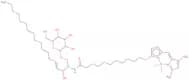
CAS:<p>Fluorogenic substrate targeting caspases 3 and 7</p>Pureza:Min. 95%Peso molecular:788.56 g/molN-(4,4-Difluoro-5,7-dimethyl-4-bora-3a,4a-diaza-s-indacene-3-dodecanoyl)sphingosyl 1-b-D-galactopyranoside
<p>N-(4,4-Difluoro-5,7-dimethyl-4-bora-3a,4a-diaza-s-indacene-3-dodecanoyl)sphingosyl 1bDgalactopyranoside is a fluorescent reagent. It has been used to detect the presence of boron in biological samples and as a substrate for enzymes. This product is also used in the diagnosis of tuberculosis and other bacterial infections. N-(4,4-Difluoro-5,7-dimethyl-4bora3a,4adiazasindacene 3dodecanoyl)sphingosyl 1bDgalactopyranoside is not intended for use in humans or animals and should be handled with care. This product is not available for sale in the state of California.</p>Pureza:Min. 95%Peso molecular:861.95 g/molD-Alanine 7-amido-4-methylcoumarin trifluoroacetate salt
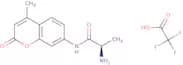
CAS:<p>D-Alanine 7-amido-4-methylcoumarin trifluoroacetate salt is a chromogenic substrate for the enzyme Beta-galactosidase. It is used as a diagnostic tool in the detection of certain bacteria, such as Enterobacteriaceae and Clostridium perfringens. It can also be used to detect the presence of beta galactosidase in food products and environmental samples. D-Alanine 7-amido-4-methylcoumarin trifluoroacetate salt has an applications in chemiluminescence, bioluminescence, and fluorescence. This product is not intended for use as a drug or food additive.</p>Fórmula:C15H15F3N2O5Pureza:Min. 95%Cor e Forma:White/Off-White SolidPeso molecular:360.29 g/mol4-Nitrophenyl 6-O-trityl-a-D-glucopyranoside
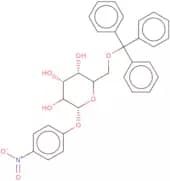
CAS:<p>4-Nitrophenyl 6-O-trityl-a-D-glucopyranoside is a high-quality trityl pNP substrate that performs excellently in various enzymatic assays. Containing a trityl-protected sugar moiety, this substrate is perfect for investigating alpha-D-glucopyranoside-specific enzymes and providing precise data for your experiments.</p>Pureza:Min. 95%Peso molecular:543.56 g/mol4-Nitrophenyl 2,6-di-O-benzoyl-a-D-galactopyranoside
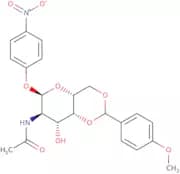
CAS:<p>4-Nitrophenyl 2,6-di-O-benzoyl-a-D-galactopyranoside is a specialized chromogenic substrate for the accurate evaluation of α-galactosidase activity. Upon enzymatic hydrolysis, it generates the chromophore 4-nitrophenol, which can be conveniently quantified by absorbance spectroscopy. The substrate features a unique benzoylated galactopyranoside moiety for enhanced selectivity and compound stability. This high-quality substrate is perfect for various research, analytical, and diagnostic applications involving α-galactosidase detection or quantification.</p>Pureza:Min. 95%Peso molecular:509.46 g/mol4-Nitrophenyl 2-acetamido-2-deoxy-4,6-O-p-methoxybenzylidene-a-D-galactopyranoside
CAS:<p>4-Nitrophenyl 2-acetamido-2-deoxy-4,6-O-p-methoxybenzylidene-a-D-galactopyranoside is a chromogenic substrate designed for the detection and quantification of enzyme activity. This methoxybenzylidene-protected compound is specifically designed to be cleaved by enzymes, releasing a yellow 4-nitrophenol product that can be easily measured spectrophotometrically. This allows for accurate and sensitive analysis of enzyme kinetics, inhibition studies, and substrate specificity determination in various applications.</p>Pureza:Min. 95%Peso molecular:460.43 g/molD-Alanine 7-amido-4-methylcoumarin free base
CAS:<p>D-Alanine 7-amido-4-methylcoumarin free base is a chromogenic substrate that is used in diagnostic testing. It is used to identify the presence of beta-lactamase, which catalyzes the hydrolysis of penicillin and cephalosporin antibiotics, by turning the substrate into a bright blue color. D-Alanine 7-amido-4-methylcoumarin free base can also be used as a fluorescent substrate for bioluminescence or chemiluminescence reactions. This product is high quality and has CAS number 201847-51-0.</p>Fórmula:C13H14N2O3Pureza:Min. 95%Peso molecular:246.26 g/mol3-Carboxyumbelliferyl b-D-galactoside BSA conjugate
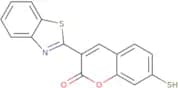
3-Carboxyumbelliferyl b-D-galactoside BSA conjugate is a fluorogenic substrate that is used in chemiluminescent enzyme assays. The reaction of this compound with the enzyme β-galactosidase leads to an increase in the intensity of light emitted by the compound, which can be measured using a luminometer. This product is often used in diagnostics, such as food testing and environmental testing, as well as high quality research.Pureza:Min. 95%3-HTC
CAS:<p>3-HTC reacts reversibly with thiols and disulfides, and can be used to measure dynamic GSH/GSSH ratios in vitro as well as to monitor the reversible redox status of whole cell lysates.(λmax: 448 nm in its reduced thiolate form, and a λmax 370-410 nm for the oxidized mixed disulfide).</p>Fórmula:C16H9NO2S2Pureza:Min. 95%Peso molecular:311.38 g/mol4-Chloromethyl-6,8-difluoroumbelliferyl b-D-galactopyranoside
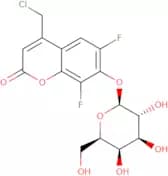
CAS:<p>4-Chloromethyl-6,8-difluoroumbelliferyl b-D-galactopyranoside is a compound commonly used in biochemical research as a fluorescent substrate for the detection of sugar hydrolase enzymes. This compound can be cleaved by enzymes such as β-galactosidase, releasing a fluorescent molecule that can be easily detected using fluorescence spectroscopy. The compound is a member of the family of umbelliferyl glycosides, which have been widely used in the study of various biochemical pathways for many years. The advantage of using this particular substrate is that the fluorescent product has a high quantum yield, which means it produces a strong signal for detection. This substrate has been used in a wide variety of applications, including the study of microbial physiology and in the development of diagnostic assays for detecting bacterial and fungal infections.</p>Pureza:Min. 95%Peso molecular:408.74 g/mol(4-Nitrophenyl)methyl-b-D-glucopyranoside
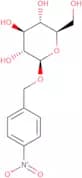
CAS:<p>This product is a fluorogenic substrate that is used in the detection of enzymes in biological systems. It is also used as a ligand to study enzyme activity and can be used to quantify enzyme activity. This product is made from high-purity, high-quality reagents and is often used as an enzyme substrate in diagnostic kits for food testing, environmental testing, and detection of bacteria with the help of chemiluminescence. The CAS number for this product is 700368-52-1. This product can be used for fluorescence staining and bioluminescence.</p>Pureza:Min. 95%Peso molecular:315.28 g/mol4-Nitrophenyl 4,6-O-benzylidene-3-O-(2,3,4,6-tetra-O-acetyl-b-D-glucopyranosyl)-b-D-glucopyranoside
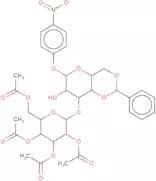
<p>4-Nitrophenyl 4,6-O-benzylidene-3-O-(2,3,4,6-tetra-O-acetyl-b-D-glucopyranosyl)-b-D-glucopyranoside is a high purity fluorescent reagent that can be used as a substrate for many enzymes. It is also used in environmental testing and to detect the presence of nitrophenols in food. This product has CAS number 545414.</p>Pureza:Min. 95%Peso molecular:719.64 g/mol4-Nitrophenyl 2-O-(a-L-fucopyranosyl)-a-D-galactopyranoside
CAS:<p>4-Nitrophenyl 2-O-(a-L-fucopyranosyl)-a-D-galactopyranoside is a chromogenic pNP enzyme substrate consisting of a fucose and galactose moieties. Upon enzymatic hydrolysis by specific fucosidases or galactosidases, it releases the highly chromogenic molecule 4-nitrophenol, which exhibits a distinct yellow color that can be monitored spectrophotometrically. This substrate is frequently used to study enzyme specificity, kinetics, and inhibition, and it plays a critical role in the investigation of carbohydrate active enzymes (CAZymes), the screening of enzyme inhibitors, and the development of novel analytical methods for the detection and quantitation of enzyme activities.</p>Pureza:Min. 95%Peso molecular:447.39 g/mol6'-(O-(Carboxymethyl))-2',7'-dichlorofluoroscein 3'-(O-(N-acetyl-b-D-glucosamide))
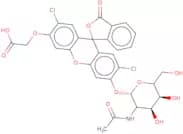
<p>6'-(O-(Carboxymethyl))-2',7'-dichlorofluoroscein 3'-(O-(N-acetyl-b-D-glucosamide)) is a chemiluminescent substrate that can be used in the detection of ligands. This product has a CAS number of 44636-76-8 and is available at a purity level of 98%. It has been tested for bacterial contamination, as well as for adverse effects on culture media and environmental testing. 6'-(O-(Carboxymethyl))-2',7'-dichlorofluoroscein 3'-(O-(N-acetyl-b-D-glucosamide)) is an enzymatic substrate that can be used in diagnostic applications such as the detection of fluorescence, staining, and bioluminescence. It has also been shown to be useful in food testing.</p>Pureza:Min. 95%Peso molecular:662.44 g/mol3-Indolyl b-D-glucuronide sodium salt
CAS:3-Indolyl b-D-glucuronide sodium salt is a specialized enzyme substrate that features an indole moiety linked to a glucuronide group. This compound is commonly used in various biochemical assays to study the activity of glucuronidase enzymes, which play a crucial role in the metabolism and detoxification of xenobiotics and endogenous compounds. The sodium salt form of this substrate ensures enhanced solubility and stability in aqueous solutions, making it a valuable tool for researchers investigating the function and regulation of glucuronidase enzymes in biological systems. 3-Indolyl b-D-glucuronide sodium salt is also used for the detection of E. coli.Pureza:Min. 95%Cor e Forma:Off-White SolidPeso molecular:331.25 g/mol4-Nitrophenyl hepta-O-acetyl-b-lactoside
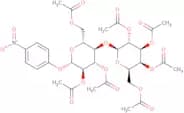
CAS:<p>4-Nitrophenyl hepta-O-acetyl-b-lactoside is a high-quality chromogenic pNP enzyme substrate that exhibits excellent sensitivity and specificity in enzyme assays. This synthetic compound is designed to react with β-galactosidase enzymes, generating a yellow product (4-nitrophenol) upon cleavage. The resulting color change allows for quantitative measurement of enzyme activity, providing valuable insights in various research applications including enzyme kinetics, screening of inhibitors, drug discovery, and molecular diagnostics. Our product ensures consistent results with minimal interference, making it a reliable choice for a wide range of biochemical applications.</p>Pureza:Min. 95%Peso molecular:757.65 g/molAquaSpark® beta-D-galactoside, lyophilized, Ramot at Tel-Aviv University Ltd. Patent family WO 2017/130191
<p>Chemiluminescence beta-galactosidase substrate</p>Pureza:Min. 95%2-Nitrophenyl 6-O-DMT-b-D-galactopyranoside
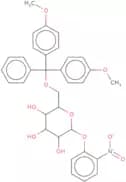
<p>N-Acetyl-2-nitrophenyl 6-O-DMT-b-D-galactopyranoside is a fluorogenic substrate that is used in enzyme and chromogenic assays, including the determination of aminoglycoside activity. This product has been shown to be suitable for detection of bacterial contamination in food products and environmental samples. N-Acetyl-2-nitrophenyl 6-O-DMT-b-D-galactopyranoside reacts with aminoglycosides at the O4 position, forming a fluorescent product that can be measured using a fluorometer.</p>Pureza:Min. 95%Peso molecular:603.62 g/mol