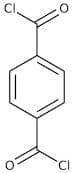
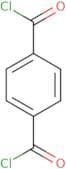
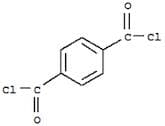
CAS 100-20-9
:Terephthaloyl chloride
- 1,4-Benzenedicarbonyl chloride
- 1,4-Bis(chlorocarbonyl)benzene
- 1,4-Di(chlorocarbonyl)benzene
- Benzene 1,4-dicarboxylic acid dichloride
- Dichlorure de terephtaloyle
- Dicloruro De Tereftaloilo
- Nsc 41885
- Terephthalic acid chloride
- Terephthalic acid dichloride
- Terephthalic dichloride
- Terephthaloyl Chloride
- Terephthaloyl Dichloride
- Terephthaloylchlorid
- Terephthaloyldichlorid
- p-Phenylenedicarbonyl dichloride
- p-Phthaloyl chloride
- p-Phthaloyl dichloride
- TCl
- benzene-1,4-dicarbonyl dichloride
- Benzene-1,4-dicarbonyl chloride
- 1,4-Benzenedicarbonyl dichloride
- TEREPHTHALYL CHLORIDE
- 1,4-BENEZENEDICARBONYL CHLORIDE
- p-phthaloyldichloride
- p-phenylenedicarbonyldichloride
- tere-Phthalicchloride
- p-Phthanoylchloride
- terephthalicacidchloride
- p-Phthalyl dichloride
- See more synonyms
Terephthaloyl chloride, 99%
CAS:Terephthaloyl chloride acts as a monomer with p-phenylenediamine used in the preparation of polymer viz. poly paraphenylene terephthalamide. It is an active component in performance polymers and aramid fibers, which gives flame resistance, chemical resistance, temperature stability, light weight, anFormula:C8H4Cl2O2Purity:99%Color and Shape:White, crystalline flakes or powderMolecular weight:203.02Terephthaloyl chloride
CAS:Formula:C8H4Cl2O2Purity:(Titration) ≥ 99.0%Color and Shape:White crystalline powder, flakes or crystalsMolecular weight:203.02Terephthaloyl chloride
CAS:Terephthaloyl chlorideFormula:C8H4Cl2O2Purity:≥95%Color and Shape:White SolidMolecular weight:203.02215Terephthaloyl Chloride
CAS:Formula:C8H4Cl2O2Purity:>99.0%(GC)(T)Color and Shape:White to Almost white powder to crystalMolecular weight:203.02Terephthaloyl Chloride
CAS:Controlled ProductApplications Terephthaloyl chloride is used as a cross-linking agent to create polymers from various types of monomers.
E0
References Edwards-Lévy, F., et al.: Int. J. Pharm., 103, 253 (1994); Lee, J., et al.: Biomacromolecules, 7, 1729 (2006); So, Y.: J. Polym. Sci. Pol. Chem., Turska, E., et al.: J. Appl. Polym. Sci., 20, 1849 (1976)Formula:C8H4Cl2O2Color and Shape:NeatMolecular weight:203.02Terephthaloyl chloride
CAS:Terephthalaldehyde chloride is a water-insoluble, white solid that is soluble in organic solvents. It forms a protective layer on metal surfaces and plastics, preventing corrosion and microbial growth. Terephthalaldehyde chloride has been shown to be effective against Escherichia coli, Klebsiella pneumoniae, Bacillus subtilis, Pseudomonas aeruginosa, Staphylococcus aureus, and Salmonella enterica. Terephthalaldehyde chloride's antimicrobial activity is attributed to its acid complex with phosphorus pentoxide and electrochemical impedance spectroscopy data indicate that it reacts with the anionic sites of bacterial cell walls. Terephthalaldehyde chloride does not react with human serum proteins or ester linkages; however, it has toxic effects on mice at high doses.
Formula:C8H4Cl2O2Purity:Min. 95%Color and Shape:PowderMolecular weight:203.02 g/molTerephthaloyl Chloride pure, 99%
CAS:Formula:C8H4O2Cl2Purity:min. 99%Color and Shape:White, Crystalline compound, Clear, ColourlessMolecular weight:203.03