CAS 100-67-4
:Potassium phenoxide
Description:
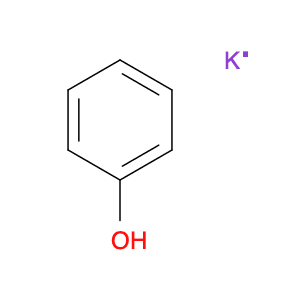
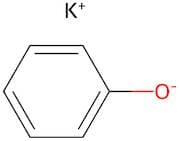
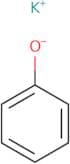
Potassium phenoxide, with the CAS number 100-67-4, is an organic compound that serves as the potassium salt of phenol. It appears as a white to off-white solid and is highly soluble in water, which is a characteristic feature of many phenoxide salts. The compound is known for its strong basicity due to the presence of the phenoxide ion, which can readily deprotonate in aqueous solutions. This property makes potassium phenoxide useful in various chemical reactions, particularly in organic synthesis as a nucleophile. It can participate in reactions such as alkylation and acylation, and it is often employed in the preparation of phenolic compounds. Additionally, potassium phenoxide can act as a catalyst in certain reactions. However, it should be handled with care, as it can be corrosive and may cause irritation upon contact with skin or eyes. Overall, potassium phenoxide is a versatile reagent in organic chemistry, valued for its reactivity and solubility.
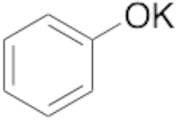
Formula:C6H5KO
InChI:InChI=1/C6H6O.K/c7-6-4-2-1-3-5-6;/h1-5,7H;/q;+1/p-1
InChI key:InChIKey=RKHQZMOCQHXUBC-UHFFFAOYSA-N
SMILES:OC1=CC=CC=C1.[K]
Synonyms:- Phenol, potassium salt
- Phenol, potassium salt (1:1)
- Phenoxypotassium
- Potassium carbolate
- Potassium phenate
- Potassium phenolate
- Potassium phenylate
- Potassium phenoxide
- Potassium phenoxyde
- potassium benzenolate
Sort by
Purity (%)
0
100
|
0
|
50
|
90
|
95
|
100
Found 5 products.
Ref: IN-DA00006Z
1g25.00€5g28.00€10g46.00€1kg681.00€25g64.00€50g96.00€100g140.00€250g200.00€500g317.00€Potassium Phenoxide
CAS:Potassium phenoxide is a synthetic compound that has antiviral properties. It is an ester of p-hydroxybenzoic acid and diphenyl ether, which is synthesized from fatty acids. The synthesis of potassium phenoxide involves the reaction of sodium phenoxide with potassium hydroxide in a nonpolar solvent. This reaction yields the desired product and diphenyl ether as reaction products. The rate at which potassium phenoxide is formed in this reaction depends on the concentration of reactants, temperature, and pH. Potassium phenoxide has been shown to have antifungal and antiseptic properties, but its activity against bacteria has not been studied.Formula:C6H5KOPurity:Min. 95%Molecular weight:132.2 g/mol