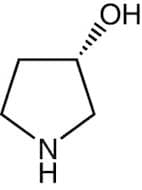
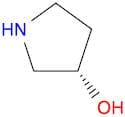
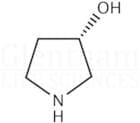
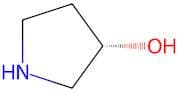
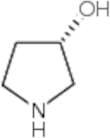
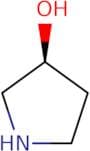
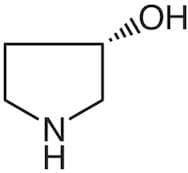
CAS 100243-39-8
:(S)-3-Hydroxypyrrolidine
- (+)-3-Pyrrolidinol
- (3R)-pyrrolidin-3-ol
- (3S)-3-Hydroxypyrrolidine
- (3S)-3-Pyrrolidinol
- (3S)-3-hydroxypyrrolidinium
- (3S)-Pyrrolidinol
- (3S)-pyrrolidin-3-ol
- (S)-3-Pyrrolidinol
- (S)-Pyrrolidin-3-ol
- 3-(S)-Hydroxypyrrolidine
- 3-Pyrrolidinol, (3S)-
- 3-Pyrrolidinol, (S)-
- (S)-3-Hydroxypyrrolidine
- (R)-3-HYDROXYPYRROLIDINE 2-BUTENEDIOATE
- (3S)-Pyrrolidine-3-ol
- (3S)-Pyrrolidin-1-ium-3-ol
- (S)-Pyrrolidine-3-ol
- (S)-(-)-3-Hydroxypyrrolidine, 99%, ee 99%
- (S)-(-)-3-HYDROXYPYRROLIDINE , EE 99%
- (S)-3-PYRROLIDINOL (S)-3-HYDROXYPYRROLIDINE
- S-HP
- (S)-3-PYRROLIDINOL 99%
- (3S)-Pyrrolidine-3β-ol
- See more synonyms
(S)-(-)-3-Hydroxypyrrolidine, 97+%, ee 98+%
CAS:(S)-(-)-3-Hydroxypyrrolidine is an important raw material and intermediate used in organic synthesis, pharmaceuticals agrochemicals and dyestuff fields. This Thermo Scientific Chemicals brand product was originally part of the Alfa Aesar product portfolio. Some documentation and label information maFormula:C4H9NOPurity:98+%Color and Shape:Crystals or powder or crystalline powder or lumps or fused solid or clear liquid as melt, Colorless to white to yellowMolecular weight:87.12Ref: IN-DA0001CT
1kgTo inquire500gTo inquire250mg21.00€1g25.00€5g46.00€10g60.00€25g124.00€100g274.00€(S)-3-Hydroxypyrrolidine
CAS:Formula:C4H9NOPurity:≥ 97.0%Color and Shape:White to light yellow solidMolecular weight:87.12(3S)-3-Hydroxypyrrolidine
CAS:(3S)-3-Hydroxypyrrolidine
Formula:C4H9NOPurity:97%Color and Shape: clear. light yellow to light brown liquidMolecular weight:87.12g/mol(S)-3-Hydroxypyrrolidine
CAS:Controlled ProductApplications (S)-3-Hydroxypyrrolidine
Formula:C4H9NOPurity:>90%Color and Shape:NeatMolecular weight:87.12(S)-3-Pyrrolidinol
CAS:3-Pyrrolidinol is a synthetic chemical that binds to the nicotinic acetylcholine receptor. It has been shown to inhibit cell growth in vitro, and may be used as an anti-cancer drug. 3-Pyrrolidinol has also been shown to have inhibitory effects on the replication of DNA in cells. The chemical reacts with hydrochloric acid to form a hydrogen bond, which enhances its ability to bind to the receptor. This reaction can be reversed by adding an acetate extract, which removes the hydrogen bond and causes the chemical to dissociate from the receptor. 3-Pyrrolidinol has a lactam ring with three functional groups (an amine group, a hydroxyl group, and a ketone group), which makes it more soluble in water than other compounds with only two functional groups. Its potential use is mainly for treating cancer or inhibiting bacterial growth.
Formula:C4H9NOPurity:Min. 95%Molecular weight:87.12 g/mol(S)-3-Pyrrolidinol
CAS:Formula:C4H9NOPurity:>97.0%(GC)(T)Color and Shape:White or Colorless to Yellow powder to lump to clear liquidMolecular weight:87.12