CAS 10026-11-6
:Zirconium chloride (ZrCl4)
Description:
Zirconium chloride (ZrCl4) is an inorganic compound characterized by its white crystalline appearance, typically forming as a solid at room temperature. It is highly soluble in polar solvents such as water and alcohol, and it can release hydrochloric acid upon hydrolysis. ZrCl4 is known for its hygroscopic nature, meaning it readily absorbs moisture from the air, which can lead to the formation of a hydrated form. The compound has a high melting point and exhibits a tetragonal crystal structure. In terms of reactivity, zirconium chloride is a Lewis acid, making it useful in various chemical reactions, including catalysis and the synthesis of organometallic compounds. It is commonly employed in the production of zirconium metal and other zirconium compounds. Safety precautions are necessary when handling ZrCl4, as it can be irritating to the skin, eyes, and respiratory system. Proper storage in a cool, dry place is recommended to prevent degradation and moisture absorption.
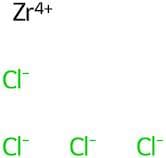
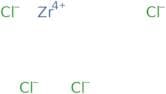
Formula:Cl4Zr
InChI:InChI=1S/4ClH.Zr/h4*1H;/q;;;;+4/p-4
InChI key:InChIKey=DUNKXUFBGCUVQW-UHFFFAOYSA-J
SMILES:[Zr](Cl)(Cl)(Cl)Cl
Synonyms:- Orgatix ZB 126
- Tetrachlorozirconium
- Tetrachlorure de zirconium
- Tetracloruro De Circonio
- Zirconium (Iv) Chloride
- Zirconium chloride
- Zirconium chloride (Zr2Cl8)
- Zirconium chloride (Zr<sub>2</sub>Cl<sub>8</sub>)
- Zirconium chloride (ZrCl4)
- Zirconium chloride (ZrCl4), (T-4)-
- Zirconium chloride (ZrCl4), tetrahydrate, (T-4)-
- Zirconium chloride (ZrCl<sub>4</sub>)
- Zirconium chloride (ZrCl<sub>4</sub>), (T-4)-
- Zirconium(4+) tetrachloride
- Zirconiumtetrachlorid
- ZrCl4
- Zirconium tetrachloride
- See more synonyms
Sort by
Purity (%)
0
100
|
0
|
50
|
90
|
95
|
100
Found 6 products.
Zirconium(IV) chloride, Reactor Grade, 99.5+% (metals basis)
CAS:Zirconium tetrachloride is commonly utilized as a Lewis acid catalyst in many organic synthesis reactions. It is an important source for organometallic complexes of zirconium. It is practiced in many areas like nuclear industry, metal industry, photography, glass, and ceramic industry. This Thermo S
Formula:Cl4ZrPurity:99.5+%Molecular weight:233.02Zirconium(IV) chloride, sublimed grade (99.95+%-Zr)
CAS:Zirconium(IV) chloride, sublimed grade (99.95+%-Zr)
Formula:ZrCl4Purity:(99.95+%-Zr)Color and Shape:white pwdr.Molecular weight:233.03Zirconium chloride, 98%
CAS:Formula:ZrCl4Purity:≥ 98% (ZrCl4 + HfCl4)Color and Shape:White powderMolecular weight:233.03Zirconium(IV) chloride
CAS:Zirconium(IV) chlorideFormula:·Zr·4ClPurity:99.5%Color and Shape:White SolidMolecular weight:233.04g/molZirconium(IV) chloride (99.5+%-Zr)
CAS:Zirconium(IV) chloride (99.5+%-Zr)
Formula:ZrCl4Purity:(99.5+%-Zr)Color and Shape:white pwdr.Molecular weight:233.03Zirconium(IV) chloride
CAS:Zirconium(IV) chloride is a unsymmetrical zirconium compound that can be prepared by the reaction of hydrochloric acid and nitrogen gas. It has been used in analytical chemistry, where it is used as a catalyst for the hydrolysis of amides. Zirconium(IV) chloride has also been used to synthesize methoxy groups, which are often found in drugs. In this way, zirconium(IV) chloride catalyses the nucleophilic attack of chlorine on an amine. The thermal expansion coefficient of zirconium(IV) chloride is very high. It also reacts with acetyl chloride or hydrogen chloride to form amide compounds. Electron microscopy images show that zirconium(IV) chloride reacts with chlorides to form crystalline clathrates.Formula:ZrCl4Purity:Min. 95%Color and Shape:PowderMolecular weight:233.03 g/mol