CAS 1003-29-8
:Pyrrole-2-carboxaldehyde
Description:
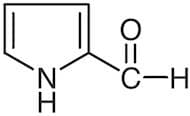
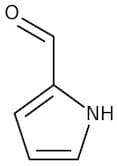
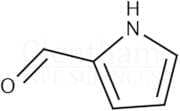
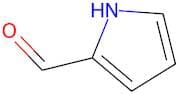
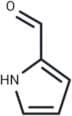
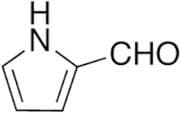
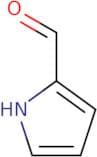
Pyrrole-2-carboxaldehyde, with the CAS number 1003-29-8, is an organic compound characterized by its pyrrole ring structure, which is a five-membered aromatic heterocycle containing nitrogen. This compound features a carboxaldehyde functional group (-CHO) attached to the second position of the pyrrole ring, influencing its reactivity and properties. Pyrrole-2-carboxaldehyde is typically a colorless to pale yellow liquid with a distinctive odor. It is soluble in organic solvents and exhibits moderate polarity due to the presence of the aldehyde group. The compound is known for its role in organic synthesis, particularly in the preparation of various heterocyclic compounds and as an intermediate in the synthesis of pharmaceuticals and agrochemicals. Its reactivity is largely attributed to the electrophilic nature of the aldehyde group, allowing it to participate in various chemical reactions, including condensation and addition reactions. Safety precautions should be observed when handling this compound, as it may pose health risks if inhaled or ingested.
Formula:C5H5NO
InChI:InChI=1/C5H5NO/c7-4-5-2-1-3-6-5/h1-4,6H
InChI key:InChIKey=ZSKGQVFRTSEPJT-UHFFFAOYSA-N
SMILES:C(=O)C1=CC=CN1
Synonyms:- 1H-Pyrrole-2-Carboxaldehyde
- 1H-Pyrrole-2-carbaldehyde
- 2-Formylpyrrole
- 2-Pyrrolaldehyde
- 2-Pyrrolecarbaldehyde
- 2-Pyrrolecarboxaldehyde
- 2-Pyrrolylcarboxaldehyde
- Nsc 112885
- Nsc 66394
- Pirrol-2-Carbaldehido
- Pyrrol-2-carbaldehyd
- Pyrrol-2-carbaldehyde
- Pyrrole-2-Carbaldehyde
- Pyrrole-2-aldehyde
- Pyrrole-2-carboxyaldehyde
- Pyrrole-2-formaldehyde
- Pyrrolecarboxaldehyde, 2-
- Pyrrole-2-carboxaldehyde
- 1H-pyrrole-2-carboxyaldehyde
- A-PYRROLALDEHYDE
- ALPHA-PYRROLALDEHYDE
- Pyrrole-2-Carboxaldehyde99%
- TIMTEC-BB SBB004389
- 1H-Pyrrole-2-carboxaldehyde99%
- 2-carboxaldehyde-1H-pyrrole
- PYRROLO-2-CARBOXALDEHYDE
- 1H-PYRROL-2-CARBOXALDEHYDE
- Pyrrole-2-carboboxaldehyde
- 1H-Pyrrole-2-carboxaldehyde 99%
- See more synonyms
Sort by
Purity (%)
0
100
|
0
|
50
|
90
|
95
|
100
Found 10 products.
Pyrrole-2-carboxaldehyde
CAS:Formula:C5H5NOPurity:>98.0%(GC)Color and Shape:White to Brown powder to crystalMolecular weight:95.10Pyrrole-2-carboxaldehyde, 99%
CAS:Pyrrole-2-carboxaldehyde is used as a pharmaceutical intermediate. It undergoes condensation reaction to produce pyrrole-2-carboxaldehyde salicylhydrazone (PCSH). It is used as a key starting material for the preparation of pyrrole -2-carboxylic acid by oxidation reaction. It is also used to prepareFormula:C5H5NOPurity:99%Color and Shape:Crystalline powder, crystals or fused solid, White to cream or brownMolecular weight:95.101H-Pyrrole-2-carboxaldehyde
CAS:1H-Pyrrole-2-carboxaldehydeFormula:C5H5NOPurity:99%Color and Shape: light fawny beige fused solidMolecular weight:95.0993g/molPyrrole-2-carboxaldehyde
CAS:Pyrrole-2-carboxaldehyde is a weak tyrosinase inhibitor that can be used in biochemical experiments and drug synthesis.Formula:C5H5NOColor and Shape:SolidMolecular weight:95.1Pyrrole-2-carboxaldehyde
CAS:Controlled ProductFormula:C5H5NOColor and Shape:NeatMolecular weight:95.11H-Pyrrole-2-carbaldehyde
CAS:1H-Pyrrole-2-carbaldehyde is a compound that belongs to the class of ferrocenecarboxylic acids. It is a coordination complex with a pyrrole system and an intramolecular hydrogen bond. The proton on the carbonyl carbon atom forms hydrogen bonds with nitrogen atoms, which are located in the immediate vicinity of the carbonyl group. The structure was determined by x-ray diffraction studies and the reactivity was studied by means of X-ray crystal structures. This compound has been used for biological studies as well as for structural analysis.
Formula:C5H5NOPurity:Min. 95%Color and Shape:PowderMolecular weight:95.1 g/molPyrrole-2-carboxaldehyde
CAS:Formula:C5H5NOPurity:97%Color and Shape:Solid, Low Melting SolidMolecular weight:95.101