CAS 1004-37-1
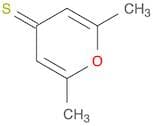
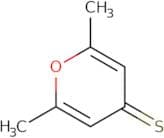
:2,6-Dimethyl-4H-pyran-4-thione
Description:
2,6-Dimethyl-4H-pyran-4-thione, with the CAS number 1004-37-1, is an organic compound characterized by its unique structure that includes a pyran ring with two methyl groups at the 2 and 6 positions and a thione functional group at the 4 position. This compound typically exhibits a yellow to brown color and is known for its distinct odor. It is soluble in organic solvents, which makes it useful in various chemical applications. The presence of the thione group imparts specific reactivity, allowing it to participate in various chemical reactions, including nucleophilic additions and cycloadditions. Additionally, 2,6-Dimethyl-4H-pyran-4-thione may exhibit biological activity, making it of interest in medicinal chemistry and agrochemicals. Its stability and reactivity can be influenced by environmental factors such as temperature and pH. Overall, this compound serves as a valuable building block in organic synthesis and may have potential applications in pharmaceuticals and materials science.
Formula:C7H8OS
InChI:InChI=1S/C7H8OS/c1-5-3-7(9)4-6(2)8-5/h3-4H,1-2H3
InChI key:InChIKey=RZGQBLWMLLDDKL-UHFFFAOYSA-N
SMILES:S=C1C=C(C)OC(C)=C1
Synonyms:- 2,6-Dimethyl-4-thiopyrone
- 2,6-Dimethylpyran-4-thione
- 4H-Pyran-4-thione, 2,6-dimethyl-
- Brn 0107420
- Nsc 75204
- 2,6-Dimethyl-4H-pyran-4-thione
- 5-17-09-00412 (Beilstein Handbook Reference)
Sort by
Purity (%)
0
100
|
0
|
50
|
90
|
95
|
100
Found 2 products.
2,6-Dimethyl-4H-pyran-4-thione
CAS:2,6-Dimethyl-4H-pyran-4-thione is a ligand that binds to metal ions and forms coordination complexes. It has been shown to be an effective catalyst for the oxidation of alcohols and amines with molecular oxygen. 2,6-Dimethyl-4H-pyran-4-thione can also be used in the synthesis of organic compounds by reacting with halides. The optical and vibrational spectra are linear at low temperatures and exponentially increase at higher temperatures. This compound can be crystallized by XRD or fluorescence methods, depending on the desired outcome. Solvents such as acetone, NMP, DMSO, THF, water, and chloroform have been shown to affect the crystal structure of this compound in varying degrees.
Formula:C7H8OSPurity:Min. 95%Molecular weight:140.2 g/mol