CAS 10049-08-8
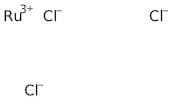
:Ruthenium chloride, (RuCl3)
Description:
Ruthenium chloride (RuCl3) is an inorganic compound characterized by its dark brown to black appearance, typically existing as a solid at room temperature. It is a transition metal halide, where ruthenium, a member of the platinum group metals, is in a +3 oxidation state. RuCl3 is known for its ability to form complexes and is often utilized as a catalyst in various chemical reactions, including organic synthesis and polymerization processes. The compound is soluble in water and can hydrolyze to form ruthenium oxides and other species in aqueous solutions. Its thermal stability allows it to withstand elevated temperatures, making it suitable for high-temperature applications. Additionally, RuCl3 exhibits interesting electronic properties, which have led to research in fields such as materials science and nanotechnology. However, it should be handled with care, as it can be toxic and irritating to the skin and respiratory system. Proper safety precautions are essential when working with this compound in laboratory settings.
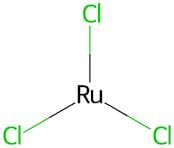
Formula:Cl3Ru
InChI:InChI=1/2ClH.Ru/h2*1H;/q;;+2/p-2
InChI key:InChIKey=YBCAZPLXEGKKFM-UHFFFAOYSA-K
SMILES:[Ru](Cl)(Cl)Cl
Synonyms:- Dichlororuthenium chloride ((RuCl2)Cl)
- Dichlororuthenium chloride ((RuCl<sub>2</sub>)Cl)
- Ruthenium Trichloride
- Ruthenium chloride
- Ruthenium chloride (RuCl<sub>3</sub>)
- Ruthenium(III) chloride
- Rutheniumtrichlorid
- Trichlorure de ruthenium
- Tricloruro De Rutenio
- Ruthenium chloride (RuCl3)
- ruthenium(3+) trichloride
- ruthenium(2+) dichloride
- RUTHENIUM (III) CHLORIDE ANHYDROUS 99+%Ruthenium sesquichloride
- Ruthenium(III)trichloride
- RUTHENIUM(III) CHLORIDE: 99.9%, ANHYDROUS
- RUTHENIUM (III) CHLORIDE-SOLUTION
- RUTHENIUM(III) CHLORIDE ANHYDROUS
- RUTHENIUM CHLORIDE (TRI)
- Ruthenium triehloride
- Ruthenium(III) chloride, anhydrous, Premion, 99.99% (metals basis), Ru 48.2% min
- RUTHENIUM(III) CHLORIDE, RU CONTENT 45-55%
- Ruthenic chloride
- rutheniumchloride(rucl3)
- Ruthenium(III) chloride, anhydrous, Premion(R), 99.99% (metals basis), Ru 48.2% min
- See more synonyms
Sort by
Purity (%)
0
100
|
0
|
50
|
90
|
95
|
100
Found 9 products.
Ruthenium(III) chloride, anhydrous, Ru 47.7% min
CAS:Ruthenium(III) chloride is widely used as a starting material of ruthenium complexes. It acts as a catalyst used in the oxidative cyclization of 1,7-dienes to oxepane diols. It is used in the hydroxylation of tertiary hydrocarbons in combination of periodate or bromate. It is involved as a catalystFormula:Cl3RuColor and Shape:Black, PowderMolecular weight:207.42Ruthenium(III) chloride, anhydrous
CAS:Ruthenium(III) chloride, anhydrous
Formula:RuCl3Color and Shape:black pwdr.Molecular weight:207.43Ruthenium(III) chloride, anhydrous, 99.95% (metals basis)
CAS:Formula:RuCl3Purity:≥ 99.95% (metals basis)Color and Shape:Dark grey to black powderMolecular weight:207.43Ruthenium(III) chloride
CAS:Ruthenium(III) chloride is a compound of ruthenium and chlorine that is used in the preparation of pharmaceuticals. Ruthenium(III) chloride reacts with potassium dichromate to form stable complexes, as well as being oxidized by picolinic acid or other oxidizing agents to form stable complexes. It has been shown to be an effective catalyst for organic synthesis reactions and biological studies have shown it can inhibit the growth of bacteria such as Mycobacterium tuberculosis by inhibiting the synthesis of proteins necessary for cell division. Ruthenium(III) chloride also forms complexes with amines and nitrogen atoms, which may be due to its ability to bind with these groups.Formula:RuCl3Purity:Min. 95%Color and Shape:Black SolidMolecular weight:207.43 g/mol