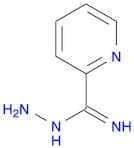
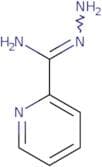
CAS 1005-02-3
:2-Pyridinecarboximidic acid, hydrazide
Description:
2-Pyridinecarboximidic acid, hydrazide, also known by its CAS number 1005-02-3, is an organic compound characterized by the presence of both a pyridine ring and a hydrazide functional group. This compound typically appears as a crystalline solid and is soluble in polar solvents due to its ability to form hydrogen bonds. The structure features a pyridine moiety, which contributes to its aromatic properties and potential biological activity, along with a carboximidic acid group that can participate in various chemical reactions, including condensation and acylation. The hydrazide functionality allows for reactivity with carbonyl compounds, making it useful in synthetic organic chemistry. Additionally, compounds of this nature may exhibit interesting pharmacological properties, which can be explored for potential applications in medicinal chemistry. Overall, 2-Pyridinecarboximidic acid, hydrazide is a versatile compound with implications in both research and industrial applications.
Formula:C6H8N4
InChI:InChI=1S/C6H8N4/c7-6(10-8)5-3-1-2-4-9-5/h1-4H,8H2,(H2,7,10)
InChI key:InChIKey=DKTIHEQAQFSEAB-UHFFFAOYSA-N
SMILES:C(NN)(=N)C1=CC=CC=N1
Synonyms:- 2-Picolinamidrazone
- 2-Pyridine amidrazone
- 2-Pyridinecarboxamidrazone
- 2-Pyridinecarboximidic acid, hydrazide
- 2-Pyridylamidrazone
- NSC 101642
- Picolinamide hydrazone
- Picolinamidrazone
- Picolinic acid amidrazone
- Picolinimidic acid, hydrazide
- Pyridine-2-Carbohydrazonamide
- Pyridine-2-carboxamide hydrazone
- Pyridine-2-hydrazidine
- See more synonyms
Sort by
Purity (%)
0
100
|
0
|
50
|
90
|
95
|
100
Found 5 products.
2-Pyridinecarbohydrazonamide
CAS:2-PyridinecarbohydrazonamideFormula:C6H8N4Purity:97%Molecular weight:136.152-Pyridinecarboximidic acid, hydrazide
CAS:Formula:C6H8N4Purity:97%Color and Shape:SolidMolecular weight:136.15452-Pyridinecarbohydrazonamide
CAS:2-PyridinecarbohydrazonamideFormula:C6H8N4Purity:97%Molecular weight:136.15N-Aminopyridine-2-carboximidamide
CAS:N-Aminopyridine-2-carboximidamide (NAP) is a potent inhibitor of the β-catenin pathway. It is used to treat autoimmune diseases and cancer. NAP inhibits the activity of amidrazone, which is an inhibitor of the β-catenin pathway in mammalian cells. NAP has been shown to inhibit tumor growth and increase survival rates in mice with cancer. NAP also inhibits chloride channels, leading to hyperpolarization of human erythrocytes, which may contribute to its anti-inflammatory activity.
Formula:C6H8N4Purity:Min. 95%Molecular weight:136.15 g/mol