CAS 100637-60-3
:(3-OXO-2,3-DIHYDRO-4H-1,4-BENZOTHIAZIN-4-YL)ACETIC ACID
Description:
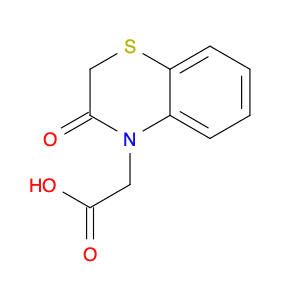
(3-OXO-2,3-DIHYDRO-4H-1,4-BENZOTHIAZIN-4-YL)ACETIC ACID, with the CAS number 100637-60-3, is a chemical compound characterized by its unique benzothiazine structure, which incorporates a ketone and an acetic acid functional group. This compound typically exhibits properties such as moderate solubility in polar solvents due to the presence of the carboxylic acid group, while its aromatic system contributes to its stability and potential for various chemical interactions. The benzothiazine moiety may impart biological activity, making it of interest in medicinal chemistry. Its molecular structure suggests potential applications in pharmaceuticals, particularly in the development of drugs targeting specific biological pathways. Additionally, the compound may undergo various chemical reactions, including esterification and acylation, which can be leveraged for further synthetic modifications. Overall, (3-OXO-2,3-DIHYDRO-4H-1,4-BENZOTHIAZIN-4-YL)ACETIC ACID represents a versatile scaffold for research and development in organic and medicinal chemistry.
Formula:C10H8NO3S
InChI:InChI=1/C10H9NO3S/c12-9-6-15-8-4-2-1-3-7(8)11(9)5-10(13)14/h1-4H,5-6H2,(H,13,14)/p-1
SMILES:c1ccc2c(c1)N(CC(=O)[O-])C(=O)CS2
Synonyms:- 4H-1,4-benzothiazine-4-acetic acid, 2,3-dihydro-3-oxo-
- (3-oxo-2,3-dihydro-4H-1,4-benzothiazin-4-yl)acetate
- (3-Oxo-2,3-dihydro-4H-1,4-benzothiazin-4-yl)acetic acid
Sort by
Purity (%)
0
100
|
0
|
50
|
90
|
95
|
100
Found 3 products.
4H-1,4-Benzothiazine-4-acetic acid, 2,3-dihydro-3-oxo-
CAS:Formula:C10H9NO3SPurity:95%Color and Shape:SolidMolecular weight:223.2484(2,3-Dihydro-3-oxo-4H-1,4-benzothiazin-4-yl)acetic acid
CAS:(2,3-Dihydro-3-oxo-4H-1,4-benzothiazin-4-yl)acetic acidPurity:96%Color and Shape:SolidMolecular weight:223.25g/mol(2,3-Dihydro-3-oxo-4H-1,4-benzothiazin-4-yl)acetic acid
CAS:Acetaminophen, also known as paracetamol, is a drug used to treat pain and fever. It is a non-narcotic analgesic that belongs to the group of carboxylic acid derivatives. Acetaminophen has been shown to have analgesic effects in animals by blocking the neural transmission at the level of the spinal cord. This drug acts centrally by inhibiting prostaglandin synthesis, decreasing body temperature, and increasing tolerance to pain. Acetaminophen may also be used for the relief of inflammatory conditions like arthritis and asthma due to its anti-inflammatory properties. Acetaminophen is metabolized in humans through conjugation with glucuronic acid and sulphate which are excreted in urine.
Formula:C10H9NO3SPurity:Min. 95%Molecular weight:223.25 g/mol