CAS 1009-89-8
:Azacycloundecan-2-one
Description:
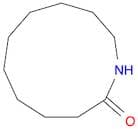
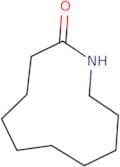
Azacycloundecan-2-one, also known by its CAS number 1009-89-8, is a cyclic compound featuring a nitrogen atom within a ten-membered ring structure. This compound is characterized by its unique azacyclic framework, which includes a ketone functional group at the second position of the ring. The presence of the nitrogen atom introduces basicity and potential for hydrogen bonding, influencing its reactivity and solubility in various solvents. Azacycloundecan-2-one is typically a colorless to pale yellow liquid or solid, depending on the temperature and purity. It exhibits moderate stability under standard conditions but may undergo reactions typical of cyclic ketones, such as nucleophilic addition or oxidation. This compound is of interest in organic synthesis and medicinal chemistry, where its structural features can be leveraged for the development of pharmaceuticals or agrochemicals. Its physical and chemical properties, such as boiling point, melting point, and solubility, can vary based on the specific conditions and purity of the sample.
Formula:C10H19NO
InChI:InChI=1S/C10H19NO/c12-10-8-6-4-2-1-3-5-7-9-11-10/h1-9H2,(H,11,12)
InChI key:InChIKey=WULPUQZASCZTPO-UHFFFAOYSA-N
SMILES:O=C1CCCCCCCCCN1
Synonyms:- 10-Aminodecanoic acid lactam
- Decanolactam
- Decanoic acid, 10-amino-, lactam
- Caprinolactam
- Azacycloundecan-2-one
Sort by
Purity (%)
0
100
|
0
|
50
|
90
|
95
|
100
Found 2 products.
Azacycloundecan-2-one
CAS:Azacycloundecan-2-one is a ring-opening polymerization monomer that exhibits good solubility in organic solvents. It is used as the precursor to polyamides and polymeric matrices. Azacycloundecan-2-one has been shown to form a film with a high degree of viscosity and excellent mechanical properties, which are desirable for films in the food industry. Ring opening polymerization of azacycloundecan-2-one can be achieved by using magnesium salts or diacids as catalysts. The lactam ring structure of azacycloundecan-2-one provides reactive sites for reactions with other compounds, such as amines, alcohols, phenols, and carboxylic acids.
Formula:C10H19NOPurity:Min. 95%Color and Shape:PowderMolecular weight:169.26 g/mol