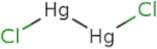
CAS 10112-91-1
:Mercury chloride (Hg2Cl2)
Description:
Mercury chloride, also known as mercurous chloride or calomel, is an inorganic compound with the formula Hg2Cl2. It appears as a white or pale yellow crystalline solid and is notable for its low solubility in water, making it a useful reagent in various chemical applications. Calomel is primarily used in electrochemical cells, as a reference electrode, and in the preparation of other mercury compounds. It exhibits a relatively low toxicity compared to other mercury compounds, but caution is still advised due to the potential for mercury exposure. The compound is stable under normal conditions but can decompose upon heating, releasing toxic mercury vapors. In addition to its chemical applications, calomel has historical significance in medicine, particularly in the 19th century, where it was used as a purgative and antiseptic. However, its use has declined due to safety concerns regarding mercury exposure. Overall, mercury chloride is an important compound in both industrial and laboratory settings, with specific handling and disposal considerations due to its mercury content.
Formula:Cl2Hg2
InChI:InChI=1S/2ClH.2Hg/h2*1H;;/q;;2*+1/p-2
InChI key:InChIKey=ZOMNIUBKTOKEHS-UHFFFAOYSA-L
SMILES:[Hg]([Hg]Cl)Cl
Synonyms:- Calogreen
- Calomel
- Calotab
- Chloromercury
- Cyclosan
- Dichlorure de dimercure
- Dicloruro De Dimercurio
- Dimercuric Dichloride
- Dimercury Dichloride
- Diquecksilberdichlorid
- Mercuric chloride
- Mercurous chloride
- Mercurous chloride (Hg2Cl2)
- Mercurous chloride (Hg<sub>2</sub>Cl<sub>2</sub>)
- Mercury chloride (Hg2Cl2)
- Mercury chloride (Hg<sub>2</sub>Cl<sub>2</sub>)
- Mercury chloromercurate(II)
- Mercury dichloride
- Mercury monochloride
- Mercury subchloride
- Mercury(II) chloride
- Mild mercury chloride
- Precipite blanc
- Quecksilber(I)-Chlorid
- See more synonyms
Sort by
Purity (%)
0
100
|
0
|
50
|
90
|
95
|
100
Found 4 products.
Mercury(I) chloride
CAS:Controlled ProductMercury chloride is a compound that consists of mercury and chlorine. It is used as an electrode in mercury-in-glass thermometers, which are used to measure temperature. Mercury chloride has also been used to detect the presence of mercurous ions in water. In addition, it is used as a reagent for qualitative determination of hydrogen peroxide and sulfur dioxide. Mercury chloride can be prepared by reacting sodium carbonate with mercurous nitrate or mercurous oxide at high temperatures. The reaction solution must be heated for about an hour to drive off the water vapor and produce the solid product. Mercury(I) chloride has been shown to have high resistance to oxidation and reduction reactions, making it a useful model system for studying redox potentials. The detection sensitivity of mercury(I) chloride is very low, but this can be increased by using t84 cells as a model system. This compound reacts with water molecules in the air, so sample preparation should include drying under vacuum or heating onFormula:Hg2Cl2Purity:Min. 95%Molecular weight:472.09 g/molMercury(I) chloride, 99.5+% (ACS)
CAS:Mercury(I) chloride, 99.5+% (ACS)
Formula:Hg2Cl2Purity:99.5+%Color and Shape:-100 mesh white pwdr.Molecular weight:472.09Mercurous Chloride pure, 98%
CAS:Formula:Hg2Cl2Purity:min. 98%Color and Shape:White to off-White, Crystalline powderMolecular weight:472.09Mercurous Chloride ACS, 99.5%
CAS:Formula:Hg2C12Purity:min.99.5%Color and Shape:White to off-white, Powder/SolidMolecular weight:472.09