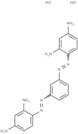
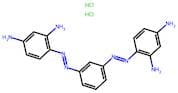
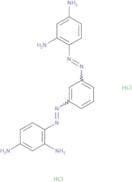
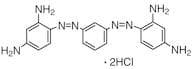
![1,3-Benzenediamine, 4,4′-[1,3-phenylenebis(2,1-diazenediyl)]bis-, hydrochloride (1:2)](/_next/image/?url=https%3A%2Fstatic.cymitquimica.com%2Fcas-image%2Fthumb-webp%2F305156-13-benzenediamine-44-13-phenylenebis-21-diazenediyl-bis-hydrochloride-1-2.webp&w=3840&q=75)
CAS 10114-58-6
:1,3-Benzenediamine, 4,4′-[1,3-phenylenebis(2,1-diazenediyl)]bis-, hydrochloride (1:2)
Description:
1,3-Benzenediamine, 4,4′-[1,3-phenylenebis(2,1-diazenediyl)]bis-, hydrochloride (1:2), commonly known as a diazo compound, is characterized by its complex structure that includes multiple aromatic amine groups and azo linkages. This compound typically appears as a solid, often with a dark color due to the presence of conjugated systems that absorb visible light. It is soluble in water and various organic solvents, which is indicative of its polar functional groups. The presence of amine groups suggests that it can participate in hydrogen bonding, influencing its reactivity and solubility. As a hydrochloride salt, it is stabilized by the chloride ion, which can affect its interaction with other substances. This compound is primarily used in dye synthesis and as an intermediate in organic reactions. However, it is important to handle it with care due to potential toxicity and environmental concerns associated with azo compounds. Proper safety measures should be observed when working with this substance in laboratory settings.
Formula:C18H18N8·2ClH
InChI:InChI=1S/C18H18N8.2ClH/c19-11-4-6-17(15(21)8-11)25-23-13-2-1-3-14(10-13)24-26-18-7-5-12(20)9-16(18)22;;/h1-10H,19-22H2;2*1H
InChI key:InChIKey=MCZVRBLCRZWFJH-UHFFFAOYSA-N
SMILES:N(=NC1=CC(N=NC2=C(N)C=C(N)C=C2)=CC=C1)C3=C(N)C=C(N)C=C3.Cl
Synonyms:- 1,3-Benzenediamine, 4,4′-[1,3-phenylenebis(2,1-diazenediyl)]bis-, hydrochloride (1:2)
- 1,3-Benzenediamine, 4,4′-[1,3-phenylenebis(azo)]bis-, dihydrochloride
- 4,4'-[(4-methylbenzene-1,3-diyl)di(E)diazene-2,1-diyl]bis(5-amino-2-methylanilinium) dichloride
- 4,4'-[benzene-1,3-diyldi(E)diazene-2,1-diyl]dibenzene-1,3-diamine
- 4,4'-[benzene-1,3-diyldi(E)diazene-2,1-diyl]dibenzene-1,3-diamine dihydrochloride
- 4-[(E)-{3-[(Z)-(2,4-diaminophenyl)diazenyl]phenyl}diazenyl]benzene-1,3-diamine dihydrochloride
- Basic Brown 1
- Basic Brown1
- Bismark Brown Y
- C.I. Basic Brown 1, dihydrochloride
Sort by
Purity (%)
0
100
|
0
|
50
|
90
|
95
|
100
Found 7 products.
Bismarck Brown
CAS:Formula:C18H18N8·2HClColor and Shape:Yellow to Dark green to Black powder to crystalMolecular weight:419.31Bismarck Brown Y
CAS:Plasma stain for mucins, cartilage and goblet cellsBismarck Brown Y is used for staining mucine, cartilage and goblet cells. This Thermo Scientific Chemicals brand product was originally part of the Alfa Aesar product portfolio. Some documentation and label information may refer to the legacy brandFormula:C18H20Cl2N8Color and Shape:Powder, Red-brown to dark brown or blackMolecular weight:419.311,3-Benzenediamine, 4,4'-[1,3-phenylenebis(2,1-diazenediyl)]bis-, hydrochloride (1:2)
CAS:Formula:C18H20Cl2N8Purity:99%Color and Shape:SolidMolecular weight:419.3110Bismark Brown Y
CAS:Bismark Brown Y is a brown dye.Formula:C18H20Cl2N8Color and Shape:Physical Description Odorless Dark Purple To Blackish-Brown Powder (Ntp 1992)Molecular weight:419.31Bismarck Brown Y (C.I. 21000)
CAS:Formula:C18H18N8·2HClColor and Shape:Light brown to reddish brown or maroon powderMolecular weight:419.32Basic Brown 1 dihydrochloride
CAS:Basic Brown 1 is a dye that has the chemical formula of C 18 H 22 ClN 2 O 3 S. It is water soluble and can be used as a stain in biological samples, such as urine or feces, to provide color contrast. Basic Brown 1 is also used as an experimental model for wastewater treatment and biological sample detection. Basic Brown 1 has been shown to be activated by hydrochloric acid and copper complex in an aqueous solution. The dye has low water permeability, which may cause it to accumulate at the surface of the bacterial strain, including gram-positive bacteria. The dye's adsorption properties are determined by thermodynamic data and kinetic values obtained from surface methodology experiments using electrochemical impedance spectroscopy (EIS).Formula:C18H20Cl2N8Color and Shape:PowderMolecular weight:419.31 g/mol


![1,3-Benzenediamine, 4,4'-[1,3-phenylenebis(2,1-diazenediyl)]bis-, hydrochloride (1:2)](/_next/image/?url=https%3A%2Fstatic.cymitquimica.com%2Fproducts%2FIN%2Fthumb%2FDA0003UM.jpg&w=3840&q=75)