CAS 1013-04-3
:4-Chloro-1-naphthoic acid
Description:
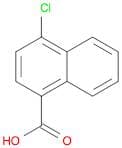
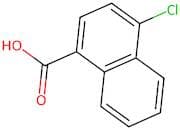
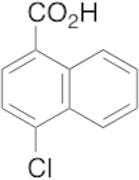
4-Chloro-1-naphthoic acid is an aromatic carboxylic acid characterized by the presence of a naphthalene ring substituted with a chlorine atom at the 4-position and a carboxylic acid group at the 1-position. Its molecular formula is C11H7ClO2, and it has a molecular weight that reflects the contributions of its constituent atoms. This compound typically appears as a white to off-white crystalline solid and is sparingly soluble in water but more soluble in organic solvents such as ethanol and acetone. 4-Chloro-1-naphthoic acid is known for its applications in organic synthesis, particularly as an intermediate in the production of various pharmaceuticals and agrochemicals. It can also serve as a reagent in chemical reactions, including those involving nucleophilic substitutions. The presence of the chlorine atom influences its reactivity and can affect the compound's biological activity, making it of interest in medicinal chemistry. Safety precautions should be taken when handling this substance, as it may pose health risks if ingested or inhaled.
Formula:C11H7ClO2
InChI:InChI=1S/C11H7ClO2/c12-10-6-5-9(11(13)14)7-3-1-2-4-8(7)10/h1-6H,(H,13,14)
SMILES:c1ccc2c(c1)c(ccc2Cl)C(=O)O
Synonyms:- 1-Naphthalenecarboxylic acid, 4-chloro-
- 4-Chloro-1-Naphthalenecarboxylic Acid
Sort by
Purity (%)
0
100
|
0
|
50
|
90
|
95
|
100
Found 5 products.
1-Naphthalenecarboxylic acid, 4-chloro-
CAS:Formula:C11H7ClO2Purity:98%Color and Shape:SolidMolecular weight:206.62514-Chloro-1-naphthoic acid
CAS:Formula:C11H7ClO2Purity:95%Color and Shape:SolidMolecular weight:206.634-Chloro-1-napthalenecarboxylic Acid
CAS:Controlled ProductFormula:C11H7ClO2Color and Shape:NeatMolecular weight:206.634-Chloro-1-napthalenecarboxylic Acid
CAS:4-Chloro-1-naphthalenecarboxylic acid (4CNA) is a naphthalene derivative that can be used as a chlorinating agent. The optical rotation of 4CNA is -8 degrees in water and +10 degrees in acetonitrile. This compound has been shown to react with alkali metals to form metal salts, which are useful for the bioluminescent detection of DNA. 4CNA yields are increased by substituent effects, such as the introduction of an electron-withdrawing group on the ring, and decreased by electron donating groups on the ring. It also has been shown to have antirheumatic properties like salicylic acid, which is known to inhibit prostaglandin synthesis.
Formula:C11H7ClO2Purity:Min. 95%Molecular weight:206.63 g/mol