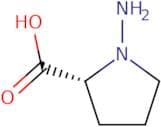
CAS 10139-05-6
:D-Proline, 1-amino-
Description:
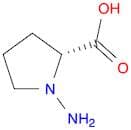
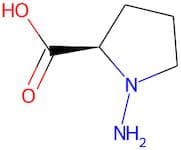
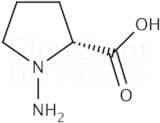
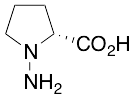
D-Proline, also known as 1-amino-2-pyrrolidinecarboxylic acid, is a naturally occurring amino acid characterized by its unique cyclic structure, which includes a five-membered ring containing a nitrogen atom. This structural feature distinguishes proline from other amino acids, as it introduces a degree of rigidity and influences the conformational properties of proteins. D-Proline is classified as a non-polar, aliphatic amino acid, and it plays a crucial role in protein synthesis and stability, particularly in collagen formation. It is also involved in various biochemical processes, including the synthesis of neurotransmitters and the regulation of cellular functions. The CAS number 10139-05-6 specifically identifies this enantiomer of proline, which is less common than its L-form but is important in certain biological contexts. D-Proline is soluble in water and exhibits a zwitterionic form at physiological pH, contributing to its reactivity and interactions in biological systems. Its unique properties make it a valuable compound in both research and pharmaceutical applications.
Formula:C5H10N2O2
InChI:InChI=1S/C5H10N2O2/c6-7-3-1-2-4(7)5(8)9/h4H,1-3,6H2,(H,8,9)/t4-/m1/s1
InChI key:InChIKey=OUCUOMVLTQBZCY-SCSAIBSYSA-N
SMILES:C(O)(=O)[C@@H]1N(N)CCC1
Synonyms:- (2R)-1-Aminopyrrolidine-2-carboxylic acid
- (R)-1-Aminopyrrolidine-2-carboxylic acid
- 1-Amino-<span class="text-smallcaps">D</span>-proline
- 1-Aminoproline
- 1-amino-D-proline
- 1-amino-L-proline
- <span class="text-smallcaps">D</span>-Proline, 1-amino-
- Proline, 1-amino-, <span class="text-smallcaps">D</span>-
- D-Proline, 1-amino-
- Proline, 1-amino-, D-
Sort by
Purity (%)
0
100
|
0
|
50
|
90
|
95
|
100
Found 5 products.
(2R)-1-aminopyrrolidine-2-carboxylic acid
CAS:Formula:C5H10N2O2Color and Shape:SolidMolecular weight:130.1451N-Amino-D-proline
CAS:Controlled ProductApplications Hydrolysis of the vitamin B6 antagonist linatine, produces the toxic compound,1-amino-D-proline. The compound possesses bacteriostatic effect toward A. vinelandii. The mechanism by which aminoproline exerts its toxic effects is unknown.
References Klosterman, H.J., et al.: Biochem., 6, 170 (1967)Formula:C5H10N2O2Color and Shape:NeatMolecular weight:130.15N-Amino-D-proline
CAS:N-Amino-D-proline is a hydrogen bond donor that has phytotoxic properties. It is synthesized from the reaction of ethanolamine, sulfoxide, and hydrochloric acid in the presence of lysine residues. N-Amino-D-proline may be used to treat death due to tissue injury or degeneration. The compound can also be used in chromatographic techniques as a hydrogen bond acceptor.
Formula:C5H10N2O2Purity:Min. 95%Color and Shape:PowderMolecular weight:130.15 g/mol