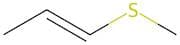
CAS 10152-77-9
:Methyl 1-propenyl sulfide
Description:
Methyl 1-propenyl sulfide, also known by its IUPAC name, is a sulfur-containing organic compound characterized by its unique structure, which includes a methyl group and a propenyl group attached to a sulfur atom. This compound typically appears as a colorless to pale yellow liquid with a distinctive odor. It is soluble in organic solvents and exhibits low solubility in water. Methyl 1-propenyl sulfide is known for its reactivity, particularly in electrophilic addition reactions due to the presence of the double bond in the propenyl group. It can participate in various chemical reactions, including polymerization and oxidation. This compound is of interest in the field of organic synthesis and may also be studied for its potential applications in flavor and fragrance industries, as well as in the development of agrochemicals. Safety precautions should be taken when handling this substance, as it may pose health risks through inhalation or skin contact.
Formula:C4H8S
InChI:InChI=1S/C4H8S/c1-3-4-5-2/h3-4H,1-2H3
InChI key:InChIKey=YJOGCMRDEUBRJD-UHFFFAOYSA-N
SMILES:C(=CC)SC
Synonyms:- 1-(Methylthio)-1-propene
- Allyl methyl sulphide
- Methyl 1-propenyl sulfide
- Methyl propenyl sulfide
- Sulfide, methyl propenyl
- 1-Propene, 1-(methylthio)-
Sort by
Purity (%)
0
100
|
0
|
50
|
90
|
95
|
100
Found 3 products.
1-Methylsulfanylprop-1-ene
CAS:1-Methylsulfanylprop-1-enePurity:98% (stabilized with BHT)Molecular weight:88.17g/molMethyl 1-propenyl sulphide
CAS:Methyl 1-propenyl sulphide is an amide that has been shown to be a potent nitro-nitrosourea (NNO) analogue with potential antineoplastic activity. In animal studies, methyl 1-propenyl sulphide has been shown to inhibit the growth of cancer cells and virus replication in vivo. This molecule also has fungicidal concentrations against Candida albicans and Aspergillus fumigatus. The methyl group in this molecule is a proton acceptor, which may contribute to its antiviral effects. Methyl 1-propenyl sulfide binds to water molecules through hydrogen bonding, which may contribute to its anti-inflammatory properties.Formula:C4H8SPurity:Min. 95%Molecular weight:88.17 g/mol