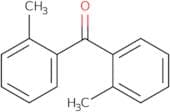
CAS 1018-97-9
:bis(2-methylphenyl)methanone
Description:
Bis(2-methylphenyl)methanone, also known as benzyl 2-methylphenyl ketone, is an organic compound characterized by its structure, which features two 2-methylphenyl groups attached to a central carbonyl (C=O) group. This compound is typically a white to pale yellow solid at room temperature and is known for its aromatic properties due to the presence of the phenyl rings. It is relatively stable under standard conditions but may undergo reactions typical of ketones, such as nucleophilic addition. Bis(2-methylphenyl)methanone is often used in organic synthesis and may serve as an intermediate in the production of various chemical compounds. Its solubility is generally limited in water but can dissolve in organic solvents like ethanol and acetone. Safety data indicates that it should be handled with care, as it may pose health risks upon exposure. Overall, bis(2-methylphenyl)methanone is a significant compound in the field of organic chemistry, particularly in the synthesis of more complex molecules.
Formula:C15H14O
InChI:InChI=1/C15H14O/c1-11-7-3-5-9-13(11)15(16)14-10-6-4-8-12(14)2/h3-10H,1-2H3
SMILES:Cc1ccccc1C(=O)c1ccccc1C
Synonyms:- Methanone, bis(2-methylphenyl)-
- Bis(2-methylphenyl)methanone
Sort by
Purity (%)
0
100
|
0
|
50
|
90
|
95
|
100
Found 2 products.
2,2'-Dimethylbenzophenone
CAS:2,2'-Dimethylbenzophenone (DMBP) is an organic compound that is used as a photoresist for semiconductor manufacturing. DMBP is soluble in many organic solvents and reacts with sodium hydroxide to form the sodium salt of 2,2'-dimethylbenzophenone. It has been shown that DMBP readily undergoes metathesis reactions with a variety of olefins. The metathesis reaction is an acid-catalyzed reaction that involves the transfer of two hydrogen atoms from the olefin to the double bond carbon atom of DMBP. The mechanism by which this occurs is not fully understood, but it may involve a one-step mechanism where the olefin binds to the carbonyl group and then reacts with one of the other groups on DMBP.Formula:C15H14OPurity:Min. 95%Molecular weight:210.27 g/mol