![ethyl [8-(1-hydroxyethyl)-1,3,4,9-tetrahydropyrano[3,4-b]indol-1-yl]acetate](/_next/image/?url=https%3A%2Fstatic.cymitquimica.com%2Fcas-image%2Fthumb-webp%2F498158-ethyl-8-1-hydroxyethyl-1349-tetrahydropyrano-34-b-indol-1-yl-acetate.webp&w=3840&q=75)
CAS 101901-08-0
:ethyl [8-(1-hydroxyethyl)-1,3,4,9-tetrahydropyrano[3,4-b]indol-1-yl]acetate
Description:
Ethyl [8-(1-hydroxyethyl)-1,3,4,9-tetrahydropyrano[3,4-b]indol-1-yl]acetate, with the CAS number 101901-08-0, is a chemical compound that belongs to a class of indole derivatives. This substance features a complex molecular structure characterized by the presence of a tetrahydropyrano ring fused to an indole moiety, which contributes to its potential biological activity. The hydroxyethyl group enhances its solubility and may influence its interaction with biological targets. Ethyl acetate, as part of its name, indicates the presence of an ester functional group, which can affect its reactivity and stability. Compounds of this nature are often studied for their pharmacological properties, including potential applications in medicinal chemistry. The specific characteristics, such as melting point, boiling point, and solubility, would depend on the compound's purity and the conditions under which it is measured. Overall, this compound's unique structure suggests it may exhibit interesting chemical behavior and biological activity, warranting further investigation in research settings.
Formula:C17H21NO4
InChI:InChI=1/C17H21NO4/c1-3-21-15(20)9-14-17-13(7-8-22-14)12-6-4-5-11(10(2)19)16(12)18-17/h4-6,10,14,18-19H,3,7-9H2,1-2H3
SMILES:CCOC(=O)CC1c2c(CCO1)c1cccc(C(C)O)c1[nH]2
Sort by
Purity (%)
0
100
|
0
|
50
|
90
|
95
|
100
Found 5 products.
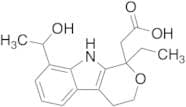
Pyrano[3,4-b]indole-1-acetic acid, 1-ethyl-1,3,4,9-tetrahydro-8-(1-hydroxyethyl)-
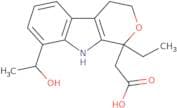
CAS:Formula:C17H21NO4Molecular weight:303.35291’-Hydroxy Etodolac
CAS:Controlled ProductFormula:C17H21NO4Color and Shape:NeatMolecular weight:303.3531’-Hydroxy etodolac
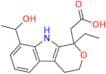
CAS:1'-Hydroxy etodolac is an inhibitor of kinases, which are enzymes that play a key role in cellular signaling pathways. It has been shown to inhibit the activity of oseltamivir carboxylate, a metabolite of the antiviral drug oseltamivir, in human urine. Additionally, 1'-Hydroxy etodolac has been found to induce apoptosis (programmed cell death) in cancer cells through its effects on protein kinase inhibitors. This analog has demonstrated potent anticancer activity against various types of tumors, including Chinese hamster lung cells and human breast cancer cells. Its potential as a therapeutic agent for cancer treatment is currently being explored.Formula:C17H21NO4Purity:Min. 95%Molecular weight:303.35 g/mol
![Pyrano[3,4-b]indole-1-acetic acid, 1-ethyl-1,3,4,9-tetrahydro-8-(1-hydroxyethyl)-](/_next/image/?url=https%3A%2Fstatic.cymitquimica.com%2Fproducts%2FIN%2Fthumb%2FDA0005VP.jpg&w=3840&q=75)