CAS 102-69-2
:Tripropylamine
Description:
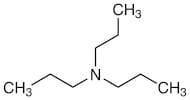
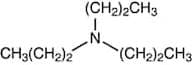
Tripropylamine is an organic compound classified as a tertiary amine, characterized by the presence of three propyl groups attached to a nitrogen atom. Its chemical formula is C9H21N, and it has a molecular weight that reflects its structure. Tripropylamine is typically a colorless to pale yellow liquid with a distinctive amine odor. It is soluble in organic solvents but has limited solubility in water due to its hydrophobic propyl chains. This compound is known for its basicity, making it useful as a catalyst and a reagent in various chemical reactions, particularly in organic synthesis and as a phase transfer catalyst. Additionally, tripropylamine can act as a surfactant and is utilized in the production of certain pharmaceuticals and agrochemicals. Safety considerations include its potential to cause irritation upon contact with skin or eyes, and it should be handled with appropriate precautions in a well-ventilated area. Overall, tripropylamine is a versatile compound with applications across multiple fields in chemistry and industry.
Formula:C9H21N
InChI:InChI=1S/C9H21N/c1-4-7-10(8-5-2)9-6-3/h4-9H2,1-3H3
InChI key:InChIKey=YFTHZRPMJXBUME-UHFFFAOYSA-N
SMILES:N(CCC)(CCC)CCC
Synonyms:- N,N,N-Tri-n-propylamine
- N,N-Dipropyl-1-propanamine
- N,N-Dipropyl-propanamine
- Propyldi-n-propylamine
- Tri-n-propylamine
- Tripropilamina
- Tripropylamin
- Tripropylamine
- N,N-dipropylpropan-1-amine acetate (1:1)
- N,N-dipropylpropan-1-amine
- Trinpropylamine
- tripropylamine,[flammableliquidlabel]
- n,n-dipropyl-1-propanamin
- (n-C3H7)3N
- N,N-dipropylpropan-1-aminium
- 1-Propanamine,N,N-dipropyl-
- N,N-Dipropyl-1-propylamine
- 1-Propanamine, N,N-dipropyl-
- 3-propylamine
- See more synonyms
Sort by
Purity (%)
0
100
|
0
|
50
|
90
|
95
|
100
Found 6 products.
Tripropylamine
CAS:Formula:C9H21NPurity:>98.0%(GC)(T)Color and Shape:Colorless to Almost colorless clear liquidMolecular weight:143.27Tri-n-propylamine, 98%
CAS:Tri-n-propylamine is used as an chemical intermediate, organic solvent. It is used in the preparation of chemical compounds such as dyes, drugs, catalyst other uses. It is used together with ruthenium in the electrochemiluminescence.This Thermo Scientific Chemicals brand product was originally partFormula:C9H21NPurity:98%Color and Shape:Liquid, Clear colorless to pale yellowMolecular weight:143.27N,N-Dipropyl-1-propanamine
CAS:Controlled ProductApplications N,N-Dipropyl-1-propanamine is a useful building block for organic synthesis.
Not a dangerous good if item is equal to or less than 1g/ml and there is less than 100g/ml in the packageFormula:C9H21NColor and Shape:NeatMolecular weight:143.27Tripropylamine
CAS:Tripropylamine is an organic compound that belongs to the group of alkylamines. It has a phase transition temperature at -37 °C and can be used as a reagent in chemical synthesis, as well as an intermediate for the production of other compounds. Tripropylamine can be detected by electrochemical impedance spectroscopy (EIS) with a detection sensitivity of 0.5 ppm. Kinetic data for tripropylamine was obtained using methyl ethyl ketone and hydrogen fluoride, which yielded k(M) = 1.2 x 10^-3 and k(S) = 2.4 x 10^-2 M-1s-1 respectively. The reaction mechanism for tripropylamine involves the formation of picolinic acid from 3-hydroxypropionic acid and ammonia, followed by decarboxylation to form picolinic acid.Formula:C9H21NPurity:Min. 95%Molecular weight:143.27 g/mol