CAS 1020-39-9
:N-(2-Chlorophenyl)benzamide
Description:
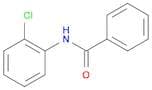
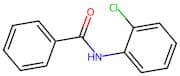
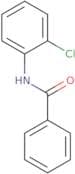
N-(2-Chlorophenyl)benzamide, with the CAS number 1020-39-9, is an organic compound characterized by its amide functional group and aromatic structure. It features a benzamide backbone where a 2-chlorophenyl group is attached to the nitrogen atom of the amide. This compound typically appears as a solid at room temperature and is known for its moderate solubility in organic solvents, while being less soluble in water due to its hydrophobic aromatic rings. The presence of the chlorine atom introduces a degree of polarity and can influence the compound's reactivity and interaction with biological systems. N-(2-Chlorophenyl)benzamide may exhibit various biological activities, making it of interest in medicinal chemistry and pharmaceutical research. Its synthesis often involves the reaction of 2-chlorobenzoic acid with an appropriate amine, followed by dehydration to form the amide. Safety data should be consulted for handling, as with many organic compounds, it may pose health risks if not managed properly.
Formula:C13H10ClNO
InChI:InChI=1S/C13H10ClNO/c14-11-8-4-5-9-12(11)15-13(16)10-6-2-1-3-7-10/h1-9H,(H,15,16)
InChI key:InChIKey=QXZRWUSAQSKAGT-UHFFFAOYSA-N
SMILES:N(C(=O)C1=CC=CC=C1)C2=C(Cl)C=CC=C2
Synonyms:- 2′-Chlorobenzanilide
- Benzanilide, 2′-chloro-
- NSC 406274
- benzamide, N-(2-chlorophenyl)-
- N-(2-Chlorophenyl)benzamide
Sort by
Purity (%)
0
100
|
0
|
50
|
90
|
95
|
100
Found 4 products.
N-(2-Chlorophenyl)benzamide
CAS:N-(2-Chlorophenyl)benzamide is a phenanthridone that reacts with chlorides in the presence of anilines to form singlet carbonyls. The photocyclization of these carbonyls yields an electron-deficient product that can be converted to a reactive electrophile by the addition of chlorine. This electrophilic species reacts with electron-rich aromatic compounds, such as phenols and benzene, to produce substitution products. The reaction rate for this process is dependent on the isotope effect, which is the change in reactivity due to changes in the mass number of atoms. The use of deuterium chloride instead of hydrogen chloride provides a kinetic isotope effect, which enhances the reaction rate.
Formula:C13H10ClNOPurity:Min. 95%Molecular weight:231.68 g/mol