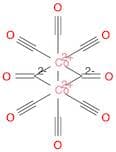
CAS 10210-68-1
:octacarbonyldicobalt
- Carbon Monooxide - Cobalt (4:1)
- Carbon Monoxide
- Cobalt
- Cobalt carbonyl
- Cobalt carbonyl (Co2(CO)8)
- Cobalt carbonyl (Co<sub>2</sub>(CO)<sub>8</sub>)
- Cobalt octacarbonyl (Co2(CO)8)
- Cobalt octacarbonyl (Co<sub>2</sub>(CO)<sub>8</sub>)
- Cobalt tetracarbonyl dimer
- Cobalt, di-μ-carbonylhexacarbonyldi-, (Co-Co)
- Cobaltous
- Di-μ-carbonylhexacarbonyldicobalt
- Dicobalt Octacarbonyl
- Dicobalt carbonyl (Co2(CO)8)
- Dicobalt carbonyl (Co<sub>2</sub>(CO)<sub>8</sub>)
- Kobalt-Tetracarbonyl, Dimer
- Methanone
- See more synonyms
Dicobalt Octacarbonyl (stabilized with 1-5% Hexane)
CAS:Formula:C8Co2O8Color and Shape:Orange to Brown to Dark red powder to crystalMolecular weight:341.95Octacarbonyldicobalt, stab. with 1-5% hexane
CAS:As a catalyst in oxo process, and in high-purity cobalt saltsFormula:C8Co2O8Purity:1-5%Color and Shape:Red to orange to brown, Crystals or powder or crystalline powder or lumpsMolecular weight:341.95Cobalt carbonyl (Dicobalt octacarbonyl) (Stabilized with 1-5% hexanes)
CAS:Cobalt carbonyl (Dicobalt octacarbonyl) (Stabilized with 1-5% hexanes)
Formula:Co2(CO)8Color and Shape:dark orange xtl.Molecular weight:341.95Cobalt Carbonyl (Stabilized with 1-5% Hexane)
CAS:Controlled ProductApplications Cobalt Carbonyl is a metal carbonyl used as a reagent and catalyst in organometallic chemistry and organic synthesis. Cobalt Carbonyl is commonly used as a hydroformylation catalyst for the conversion of alkenes to aldehydes.
Not a dangerous good if item is equal to or less than 1g/ml and there is less than 100g/ml in the package
References Mirbach, M. et al.: J. Am. Chem. Soc., 103, 7594 (1981); Haukka, M. et al.: J. Mol. Cat. A Chem., 102, 79 (1995); Haumann, M. et al.: Catal. Tod., 79, 43 (2003);Formula:C8Co2O8Color and Shape:NeatMolecular weight:341.95Cobalt, di-μ-carbonylhexacarbonyldi-, (Co-Co)
CAS:Formula:C8Co2O8Purity:98%Color and Shape:SolidMolecular weight:341.9472Dicobalt Octacarbonyl (stabilized with 1-10% Hexane)
CAS:Dicobalt octacarbonyl is a carbonylative agent that converts alkenes to epoxides. It is used in the synthesis of cyclopentenones, as well as in the conversion of benzylic alcohols to aldehydes. Dicobalt octacarbonyl has been shown to react with glycosyl compounds, such as glycosides and cyclitols, to form carbon dioxide and water. This reaction produces very little hydrogen gas and no free radicals, which makes it useful for applications where these byproducts are undesirable.
Formula:C8Co2O8Purity:Min. 95%Molecular weight:341.95 g/molRef: 3D-FD60932
Discontinued product