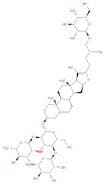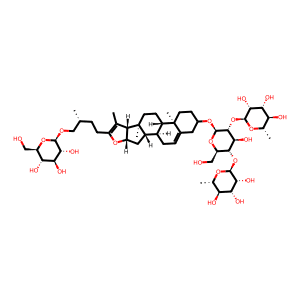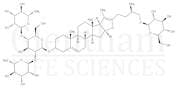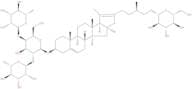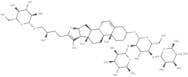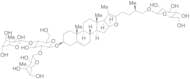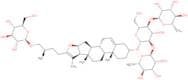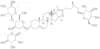
CAS 102115-79-7
:PROTOGRACELLIN
Description:
Protogracellin, identified by its CAS number 102115-79-7, is a chemical compound that belongs to a class of substances known for their biological activity. While specific characteristics such as molecular weight, structure, and solubility may vary, compounds in this category often exhibit properties that make them of interest in pharmacological and biochemical research. Protogracellin may possess unique functional groups that contribute to its reactivity and interaction with biological systems. Additionally, it may demonstrate specific spectral properties, such as UV-Vis or NMR spectra, which can be utilized for identification and analysis. The compound's potential applications could range from medicinal chemistry to agricultural science, depending on its biological effects and mechanisms of action. However, detailed information regarding its toxicity, stability, and environmental impact would require further investigation through scientific literature and experimental studies. As with any chemical substance, proper handling and safety protocols should be observed when working with protogracellin.
Formula:C51H82O21
InChI:InChI=1S/C51H82O21/c1-20(19-64-46-40(60)39(59)36(56)31(17-52)69-46)7-10-29-21(2)33-30(68-29)16-28-26-9-8-24-15-25(11-13-50(24,5)27(26)12-14-51(28,33)6)67-49-45(72-48-42(62)38(58)35(55)23(4)66-48)43(63)44(32(18-53)70-49)71-47-41(61)37(57)34(54)22(3)65-47/h8,20,22-23,25-28,30-49,52-63H,7,9-19H2,1-6H3/t20-,22+,23+,25+,26-,27+,28+,30+,31-,32-,33+,34+,35+,36-,37-,38-,39+,40-,41-,42-,43+,44-,45-,46-,47+,48+,49-,50+,51+/m1/s1
InChI key:InChIKey=MDCUMTGKKLOMCW-XNVNDPJESA-N
SMILES:C[C@@]12[C@]([C@]3([C@](CC1)([C@]4(C)C(=CC3)C[C@@H](O[C@H]5[C@H](O[C@H]6[C@H](O)[C@H](O)[C@@H](O)[C@H](C)O6)[C@@H](O)[C@H](O[C@H]7[C@H](O)[C@H](O)[C@@H](O)[C@H](C)O7)[C@@H](CO)O5)CC4)[H])[H])(C[C@]8([C@@]2(C(C)=C(CC[C@H](CO[C@@H]9O[C@H](CO)[C@@H](O)[C@H](O)[C@H]9O)C)O8)[H])[H])[H]
Synonyms:- (3β,25R)-26-(β-<span class="text-smallcaps">D</smallcap>-Glucopyranosyloxy)furosta-5,20(22)-dien-3-yl O-6-deoxy-α-<smallcap>L</smallcap>-mannopyranosyl-(1→2)-O-[6-deoxy-α-<smallcap>L</smallcap>-mannopyranosyl-(1→4)]-β-<smallcap>D</span>-glucopyranoside
- Oligofurostanoside A
- Protodioscin, Pseudo-
- Pseudo-Protodioscin
- Pseudoprotodioscin
- Pseudoprototribestin
- β-<span class="text-smallcaps">D</smallcap>-Glucopyranoside, (3β,25R)-26-(β-<smallcap>D</smallcap>-glucopyranosyloxy)furosta-5,20(22)-dien-3-yl O-6-deoxy-α-<smallcap>L</smallcap>-mannopyranosyl-(1→2)-O-[6-deoxy-α-<smallcap>L</span>-mannopyranosyl-(1→4)]-
Sort by
Purity (%)
0
100
|
0
|
50
|
90
|
95
|
100
Found 7 products.
β-D-Glucopyranoside, (3β,25R)-26-(β-D-glucopyranosyloxy)furosta-5,20(22)-dien-3-yl O-6-deoxy-α-L-mannopyranosyl-(1→2)-O-[6-deoxy-α-L-mannopyranosyl-(1→4)]-
CAS:Formula:C51H82O21Purity:96%Color and Shape:SolidMolecular weight:1031.1842Pseudoprotodioscin
CAS:Pseudoprotodioscin exhibits anti-inflammatory and anticancer activities, it shows a weaker suppressing effect on the production of inflammatory cytokines, and can suppress melanogenesis in B16F1 cells.Formula:C51H82O21Purity:95%~99%Molecular weight:1031.2Pseudoprotodioscin
CAS:1. Pseudoprotodioscin has moderate cytotoxicity.Formula:C51H82O21Purity:99.19% - ≥95%Color and Shape:SolidMolecular weight:1031.18Ref: TM-T5S0246
2mg39.00€5mg62.00€10mg94.00€1mL*10mM (DMSO)99.00€25mg137.00€50mg193.00€100mg286.00€200mg423.00€Pseudoprotodioscin
CAS:Controlled ProductStability Hygroscopic
Applications Pseduoprotodioscin (CAS# 102115-79-7) is a steroidal saponin extracted from plants such as those of the genus Dioscorea spongiosa II, and exhibits cytotoxic effects against human colorectal carcinoma and gastric cancer cells.
References Ruan, J.; et al.: Shenyang Yaoke Daxue Xuebao, 33, 438 (2016); Liang, F.; et al.: Phytochemistry Letters, 16, 294 (2016).Formula:C52H84O20Color and Shape:NeatMolecular weight:1029.21Pseudoprotodioscin
CAS:Pseudoprotodioscin is a bioactive saponin compound, which is primarily derived from various plant sources, including members of the genus Tribulus. The compound is part of a larger family of steroidal saponins known for their diverse biological activities. Its mode of action includes influencing cellular pathways through modulation of enzyme activity and interaction with steroid hormone receptors, contributing to its bioactivity.Formula:C51H82O21Purity:Min. 95%Color and Shape:White PowderMolecular weight:1,031.18 g/mol