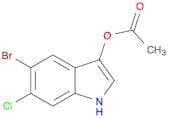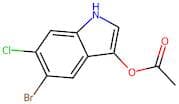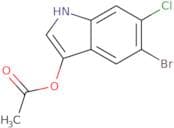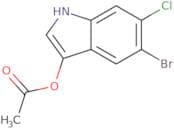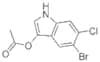
CAS 102185-48-8
:5-bromo-6-chloro-3-indolyl acetate
Description:
5-Bromo-6-chloro-3-indolyl acetate is a synthetic organic compound that belongs to the class of indole derivatives. It is characterized by the presence of both bromine and chlorine substituents on the indole ring, which contribute to its unique chemical properties and reactivity. The acetate group enhances its solubility in organic solvents and can influence its biological activity. This compound is often utilized in biochemical research, particularly in studies involving enzyme activity and as a substrate in various assays due to its ability to undergo hydrolysis. Its structural features allow it to participate in electrophilic aromatic substitution reactions, making it a valuable intermediate in organic synthesis. Additionally, the presence of halogen atoms can impart specific electronic effects, potentially affecting the compound's interaction with biological targets. Safety data should be consulted before handling, as halogenated compounds can pose health risks. Overall, 5-bromo-6-chloro-3-indolyl acetate is an important compound in the field of medicinal chemistry and biochemistry.
Formula:C10H7BrClNO2
Sort by
Purity (%)
0
100
|
0
|
50
|
90
|
95
|
100
Found 5 products.
1H-Indol-3-ol, 5-bromo-6-chloro-, 3-acetate
CAS:Formula:C10H7BrClNO2Purity:%Color and Shape:SolidMolecular weight:288.52515-Bromo-6-chloro-3-indoxyl-3-acetate
CAS:5-Bromo-6-chloro-3-indoxyl-3-acetatePurity:98%Color and Shape:SolidMolecular weight:288.53g/mol5-Bromo-6-chloro-3-indolyl acetate
CAS:5-Bromo-6-chloro-3-indolyl acetate is a chromogenic substrate that yields a magenta-colored product after cleavage. The chromophore 5-bromo-6-chloro-indoxyl is released, generating the observable color. It is used in bacterial esterase detection (e.g. Staphylococcus spp.).
Formula:C10H7BrClNO2Purity:Min. 98 Area-%Color and Shape:PowderMolecular weight:288.52 g/mol5-Bromo-6-chloro-3-indoxyl-3-acetate
CAS:Chromogenic substrate for carboxylesterase yielding a magenta precipitate upon cleavage. Mainly used in histochemistry.Formula:C10H7BrClNO2Purity:Min. 98.0 Area-%Molecular weight:288.53 g/molRef: 3D-B-6304
1gTo inquire5gTo inquire10gTo inquire500mgTo inquire2500mgTo inquire-Unit-ggTo inquire