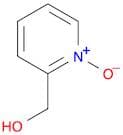
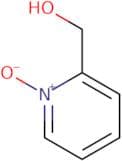
CAS 10242-36-1
:2-Pyridinemethanol, 1-oxide
- (1-Oxidopyridin-2-Yl)Methanol
- 2-(Hydroxymethyl)pyridin-1-ium-1-olate
- 2-(Hydroxymethyl)pyridine 1-oxide
- 2-(Hydroxymethyl)pyridine N-oxide
- 2-Picolyl alcohol 1-oxide
- 2-Pyridinemethanol N-oxide
- 2-Pyridinemethanol, 1-oxide
- 2-Pyridylcarbinol N-oxide
- 2-Pyridylmethanol N-oxide
2-(Hydroxymethyl)pyridine N-Oxide
CAS:Controlled ProductApplications 2-(Hydroxymethyl)pyridine N-Oxide (cas# 10242-36-1) is a compound useful in organic synthesis.
Formula:C6H7NO2Color and Shape:NeatMolecular weight:125.132-(Hydroxymethyl)pyridine N-oxide
CAS:2-(Hydroxymethyl)pyridine N-oxide is a model system that was originally synthesized to study the mechanism of perchlorate and amine degradation in vivo. It has been shown to be an excellent model for studying the oxidative decomposition of n-oxides with metal ions, as well as their transformation into monomers. 2-(Hydroxymethyl)pyridine N-oxide reacts with chloride ion to form 2-(hydroxymethyl)pyridine N-oxide chloride. The reaction of 2-(hydroxymethyl)pyridine N-oxide with a sulfoxide produces an adduct that can be used to study hydrogen bonding. 2-(Hydroxymethyl)pyridine N-oxide has biological properties and is a potential drug candidate for the treatment of cancer.
Formula:C6H7NO2Purity:Min. 95%Molecular weight:125.13 g/molRef: 3D-FH24412
Discontinued product