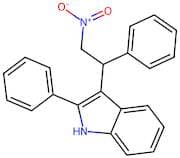
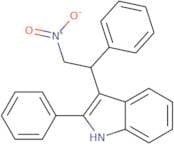
CAS 102704-40-5
:3-(2-Nitro-1-phenylethyl)-2-phenyl-1H-indole
Description:
3-(2-Nitro-1-phenylethyl)-2-phenyl-1H-indole, with the CAS number 102704-40-5, is a synthetic organic compound that belongs to the indole family, characterized by its complex structure featuring both indole and nitro groups. This compound typically exhibits a yellow to orange color due to the presence of the nitro group, which can influence its electronic properties and reactivity. It is likely to be soluble in organic solvents, such as ethanol and dichloromethane, while being less soluble in water due to its hydrophobic indole structure. The presence of the nitro group may impart certain biological activities, making it of interest in medicinal chemistry and pharmacology. Additionally, the compound's structure suggests potential applications in organic synthesis and material science. As with many nitro compounds, it may be sensitive to heat and shock, necessitating careful handling and storage. Overall, 3-(2-Nitro-1-phenylethyl)-2-phenyl-1H-indole is a notable compound for research in various chemical and biological fields.
Sort by
Purity (%)
0
100
|
0
|
50
|
90
|
95
|
100
Found 3 products.
GAT211
CAS:GAT211 (AZ-4) is a cannabinoid 1 receptor (CB1R) positive allosteric modulator (PAM) for the study of epilepsy.Formula:C22H18N2O2Purity:99.7%Color and Shape:SolidMolecular weight:342.39Ref: TM-T27405
1mg34.00€5mg66.00€10mg90.00€25mg148.00€50mg210.00€100mg310.00€500mg750.00€1mL*10mM (DMSO)73.00€3-(2-Nitro-1-phenylethyl)-2-phenyl-1H-indole
CAS:3-(2-Nitro-1-phenylethyl)-2-phenyl-1H-indole is a research tool that can be used in cell biology, pharmacology, and ion channels. It is an inhibitor of ligand binding to receptor proteins. 3-(2-Nitro-1-phenylethyl)-2-phenyl-1H-indole has been shown to activate ion channels, with the potency depending on pH and membrane potentials. This compound has also been shown to inhibit the activity of peptides and antibodies in protein interactions. The purity of this product is high and it is suitable for use in life science experiments as well as antibody production.Formula:C22H18N2O2Purity:Min. 95%Molecular weight:342.4 g/mol