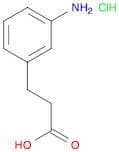
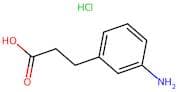
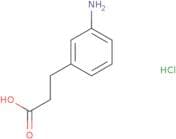
CAS 102879-44-7
:Benzenepropanoic acid, 3-amino-, hydrochloride (1:1)
Description:
Benzenepropanoic acid, 3-amino-, hydrochloride (1:1), also known as 3-amino-phenylpropanoic acid hydrochloride, is an organic compound characterized by its aromatic structure and the presence of both an amino group and a carboxylic acid group. This compound typically appears as a white to off-white crystalline solid and is soluble in water due to the presence of the hydrochloride salt form, which enhances its solubility compared to the free base. The amino group contributes to its basicity, while the carboxylic acid group imparts acidic properties, making it a zwitterionic compound under certain pH conditions. It is often used in biochemical research and pharmaceutical applications, particularly in the synthesis of various derivatives and as a building block in drug development. The compound's properties, such as melting point and stability, can vary based on environmental conditions and the presence of other substances. Safety data should be consulted for handling and storage, as with any chemical substance.
Formula:C9H11NO2·ClH
InChI:InChI=1S/C9H11NO2.ClH/c10-8-3-1-2-7(6-8)4-5-9(11)12;/h1-3,6H,4-5,10H2,(H,11,12);1H
InChI key:InChIKey=QBOBODDISCLHPG-UHFFFAOYSA-N
SMILES:C(CC(O)=O)C1=CC(N)=CC=C1.Cl
Synonyms:- 3-(3-Aminophenyl)propanoic acid hydrochloride (1:1)
- Benzenepropanoic acid, 3-amino-, hydrochloride (1:1)
- Hydrocinnamic acid, m-amino-, hydrochloride
Sort by
Purity (%)
0
100
|
0
|
50
|
90
|
95
|
100
Found 4 products.
3-(3-Aminophenyl)propanoic acid hydrochloride
CAS:3-(3-Aminophenyl)propanoic acid hydrochloridePurity:97%Molecular weight:201.65g/molbeta-(3-Aminophenyl)propionic acid hydrochloride
CAS:Beta- (3-aminophenyl)propionic acid hydrochloride is a drug that belongs to the class of pharmaceuticals and is used as a gastric antacid. It has been shown to be effective in treating acute and chronic gastritis, as well as ulcers in humans. Beta-(3-aminophenyl)propionic acid hydrochloride has been shown to have strong effects on tissues, membranes, and chlorides. The drug binds to hydrogen chloride and chlorine ions in the stomach, thereby preventing the formation of hydrochloric acid (HCL). This prevents the damage caused by HCL on tissues and membranes of the stomach. Beta-(3-aminophenyl)propionic acid hydrochloride also has health effects with high concentrations, such as chloroform or chlorine gas.Formula:C9H12ClNO2Purity:Min. 95%Molecular weight:201.65 g/mol