CAS 10296-47-6
:3-CHLORO-5-NITROISOQUINOLINE
Description:
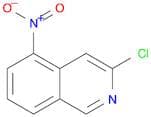
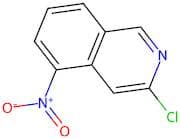
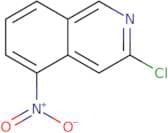
3-Chloro-5-nitroisoquinoline is a heterocyclic organic compound characterized by the presence of both a chlorine atom and a nitro group attached to an isoquinoline ring system. The isoquinoline structure consists of a fused benzene and pyridine ring, contributing to its aromatic properties. The chlorine substituent at the 3-position and the nitro group at the 5-position influence the compound's reactivity and polarity, making it a potential candidate for various chemical reactions, including electrophilic substitution and nucleophilic attack. This compound may exhibit biological activity, which is of interest in medicinal chemistry, particularly in the development of pharmaceuticals. Its properties, such as solubility, melting point, and stability, can vary based on the solvent and environmental conditions. As with many nitro-containing compounds, it may also pose certain hazards, including potential toxicity and environmental impact, necessitating careful handling and disposal. Overall, 3-chloro-5-nitroisoquinoline serves as a valuable compound in research and development within organic and medicinal chemistry.
Formula:C9H5ClN2O2
InChI:InChI=1/C9H5ClN2O2/c10-9-4-7-6(5-11-9)2-1-3-8(7)12(13)14/h1-5H
SMILES:c1cc2cnc(cc2c(c1)N(=O)=O)Cl
Synonyms:- Isoquinoline, 3-Chloro-5-Nitro-
Sort by
Purity (%)
0
100
|
0
|
50
|
90
|
95
|
100
Found 4 products.
3-Chloro-5-nitroisoquinoline
CAS:Formula:C9H5ClN2O2Purity:98%Color and Shape:SolidMolecular weight:208.60123-Chloro-5-nitroisoquinoline
CAS:3-Chloro-5-nitroisoquinoline is a heterocyclic compound that belongs to the isoquinoline class. It can be synthesized by reacting 3,4,5-trichlorobenzaldehyde with ammonia and sodium nitrite in an aqueous solution. The synthesis of this compound has been shown to produce two isomers, thiazolo and thiazole. Spectroscopic data for this compound have been obtained in the solid state and in solution. The spectra show strong absorptions at about 250 nm and at about 590 nm. The heterocyclic ring has a nitrogen atom as one of its members, which is responsible for the absorption at around 250 nm. The absorption at 590 nm is due to the presence of an aromatic ring system.
Formula:C9H5ClN2O2Purity:Min. 95%Molecular weight:208.6 g/mol