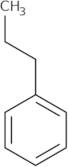
CAS 103-65-1
:Benzene, propyl-
Description:
Benzene, propyl- (CAS 103-65-1), also known as propylbenzene, is an aromatic hydrocarbon characterized by a propyl group attached to a benzene ring. It is a colorless liquid with a sweet, aromatic odor, and it is insoluble in water but soluble in organic solvents. Propylbenzene has a relatively low boiling point and a moderate vapor pressure, making it volatile under standard conditions. It is primarily used as an intermediate in the production of various chemicals, including styrene and other derivatives. The compound exhibits typical properties of aromatic compounds, such as stability due to resonance and a tendency to undergo electrophilic substitution reactions. Additionally, propylbenzene is flammable and should be handled with care, as it can pose health risks upon inhalation or skin contact. Its environmental impact is also a consideration, as it can contribute to air pollution and may have toxic effects on aquatic life. Overall, propylbenzene is an important compound in industrial chemistry with specific handling and safety requirements.
Formula:C9H12
InChI:InChI=1/C9H12/c1-2-6-9-7-4-3-5-8-9/h3-5,7-8H,2,6H2,1H3
InChI key:InChIKey=ODLMAHJVESYWTB-UHFFFAOYSA-N
SMILES:C(CC)C1=CC=CC=C1
Synonyms:- 1-Phenylpropane
- 1-Propylbenzene
- Isocumene
- Nsc 16941
- Propilbenceno
- Propylbenzene
- Propylbenzol
- n-Propylbenzene
- 4-N-Propyl Benzene
- Isocomene
- Benzene, propyl-
- propyl benzene
- N-PROPYLBENZENE, 1X1ML, MEOH, 5000UG/ML
- Propylbenzene, N-(Isocumene)
- N-PROPYLBENZENE/ISOCUMENE
- Phenylpropane
- propyl-benzen
- #nn-Propylbenzene
- n-Popyl benzene
- propylbenzene solution
- PROPYLBENZENE, STANDARD FOR GC
- N-PROPYLBENZENE, 1 GRAM, NEAT
- See more synonyms
Sort by
Purity (%)
0
100
|
0
|
50
|
90
|
95
|
100
n-Propylbenzene
CAS:n-Propylbenzene is a chemical compound that is used to make detergent compositions. It has chemical reactions with hydroxyl groups and can be used as a reactant in the production of polymers. The rate of the reaction depends on the kinetic energy, which is increased by increasing the temperature. The wild-type strain was shown to have a higher formation rate of n-propylbenzene than its mutant counterpart. The rate of reaction at different concentrations can be determined using linear regression analysis and nuclear magnetic resonance spectroscopy.Formula:C9H12Purity:Min. 95%Molecular weight:120.19 g/molRef: 3D-FP54926
Discontinued product