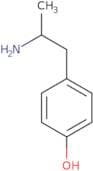
CAS 103-86-6
:Hydroxyamphetamine
Description:
Hydroxyamphetamine, with the CAS number 103-86-6, is a chemical compound that belongs to the class of phenethylamines. It is structurally related to amphetamine and is characterized by the presence of a hydroxyl group (-OH) attached to the aromatic ring. This modification can influence its pharmacological properties, making it a compound of interest in medicinal chemistry. Hydroxyamphetamine is known to exhibit stimulant effects and can act as a sympathomimetic agent, potentially affecting neurotransmitter release and reuptake in the central nervous system. The compound is often studied for its potential applications in treating conditions such as attention deficit hyperactivity disorder (ADHD) and narcolepsy. In terms of physical properties, hydroxyamphetamine is typically a solid at room temperature and may exhibit solubility in polar solvents. Safety and handling precautions are essential, as with many psychoactive substances, due to potential side effects and regulatory considerations. Overall, hydroxyamphetamine represents a significant compound in the study of psychoactive drugs and their therapeutic applications.
Formula:C9H13NO
InChI:InChI=1S/C9H13NO/c1-7(10)6-8-2-4-9(11)5-3-8/h2-5,7,11H,6,10H2,1H3
InChI key:InChIKey=GIKNHHRFLCDOEU-UHFFFAOYSA-N
SMILES:C(C(C)N)C1=CC=C(O)C=C1
Synonyms:- 1-p-Hydroxyphenyl-2-propylamine
- 2-Amino-1-(p-hydroxyphenyl)propane
- 4-Hydroxy-alpha-methylphenethylamine
- 4-Hydroxy-α-methylphenethylamine
- 4-Hydroxyamphetamine
- <span class="text-smallcaps">DL</span>-4-Hydroxyamphetamine
- Brn 2413849
- Hydroxyamfetamine
- Hydroxyamphetamine
- Norpholedrine
- Norveritol
- Nov-Pholedrin
- Nsc 170995
- Oksamfetamin
- Oxamfetamin
- Oxamphetamine
- Oxamphetaminium
- Paradrine
- Paredrine
- Paredrinex
- Pedrolon
- Phenol, 4-(2-aminopropyl)-
- Phenol, 4-(2-aminopropyl)- (9CI)
- Phenol, p-(2-aminopropyl)-
- Pulsoton
- Racemic p-hydroxyamphetamine
- Unii-Fqr280Jw2N
- alpha-Methyltyramine
- dl-p-Hydroxyamphetamine
- p-(2-Aminopropyl)phenol
- p-Hydroxy-alpha-methylphenethylamine
- p-Hydroxy-α-methylphenethylamine
- p-Hydroxyamphetamine
- p-Hydroxyphenylisopropylamine
- α-Methyltyramine
- See more synonyms
Sort by
Purity (%)
0
100
|
0
|
50
|
90
|
95
|
100
Found 1 products.
4-(2-Aminopropyl)phenol
CAS:Controlled Product4-(2-Aminopropyl)phenol is a chemical that is used as a diagnostic and pharmacological agent. It is also known to be a potent inhibitor of dopamine uptake in the brain, and has been shown to affect locomotor activity in a clinical study. 4-(2-Aminopropyl)phenol may be an experimental model for infectious diseases such as malaria, which causes high levels of dopamine release from the central nervous system. It inhibits the oxidation of dopamine by reactive oxygen species (ROS), which prevents the formation of toxic products and protects against oxidative stress. 4-(2-Aminopropyl)phenol has been shown to cause death in liver cells by binding with nitrogen atoms, inhibiting cellular respiration through inhibition of cytochrome P450 enzymes.Formula:C9H13NOPurity:Min. 95%Molecular weight:151.21 g/mol