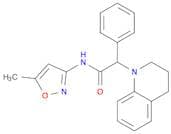
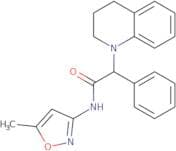
CAS 1031496-06-6
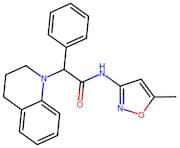
:N-(5-methyl-1,2-oxazol-3-yl)-2-phenyl-2-(1,2,3,4-tetrahydroquinolin-1-yl)acetamide
- CIM 0216
- N-(5-methyl-1
- 4-tetrahydroquinolin-1-yl)acetamide
- 2-oxazol-3-yl)-2-phenyl-2-(1
- N-(5-methyl-1,2-oxazol-3-yl)-2-phenyl-2-(1,2,3,4-tetrahydroquinolin-1-yl)acetamide
- 1(2H)-Quinolineacetamide, 3,4-dihydro-N-(5-methyl-3-isoxazolyl)-α-phenyl-
- cim-0216,cim0216,inflammation,inhibit,TRP Channel,Transient receptor potential channels,sensory nerve,neurogenic,TRPM3,Inhibitor,CIM 0216
- 3,4-Dihydro-N-(5-methyl-3-isoxazolyl)-α-phenyl-1(2H)-quinolineacetamide
N-(5-methyl-1,2-oxazol-3-yl)-2-phenyl-2-(1,2,3,4-tetrahydroquinolin-1-yl)acetamide
CAS:Formula:C21H21N3O2Purity:95%Color and Shape:SolidMolecular weight:347.4103cim0216
CAS:CIM0216 is a synthetic TRPM3 activator whose potency and apparent affinity greatly exceeds that of the canonical TRPM3 agonist.Formula:C21H21N3O2Purity:99.87%Color and Shape:SolidMolecular weight:347.41Ref: TM-T9263
1mg44.00€2mg56.00€5mg87.00€1mL*10mM (DMSO)96.00€10mg138.00€25mg281.00€50mg442.00€100mg665.00€500mg1,378.00€N-(5-methyl-1,2-oxazol-3-yl)-2-phenyl-2-(1,2,3,4-tetrahydroquinolin-1-yl)acetamide
CAS:Purity:≥98%(HPLC)Molecular weight:347.4179993CIM 0216
CAS:Applications CIM 0216 is a synthetic transient receptor potential cation channel subfamily M member (TRPM3) activator. Also, it stimulates the release of insulin from pancreatic islet cells.
References Held, K., et al.: Proc. Natl. Acad. Sci. U.S.A., 112, 1363-1372 (2015);Formula:C21H21N3O2Color and Shape:Off White PowderMolecular weight:347.41Adriamycin
CAS:Adriamycin is a chemotherapeutic drug that has been used in the treatment of cancer. It is an anthracycline antibiotic that inhibits the growth of tumor cells by interfering with DNA synthesis and cell division. Adriamycin binds to the dna template strand at the site of a single-stranded break in the DNA chain and forms a covalent bond with it, thereby preventing replication and transcription. Adriamycin also inhibits mitochondrial functions, leading to congestive heart failure and cardiac arrest. This drug also causes cell death through its ability to bind to nuclear DNA as well as cell factor (a protein complex) on the surface of cells.
Formula:C21H21N3O2Purity:Min. 95%Molecular weight:347.42 g/mol