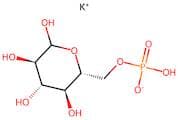
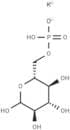
CAS 103192-55-8
:D-glucose 6-phosphate monopotassium
Description:
D-glucose 6-phosphate monopotassium is a phosphorylated derivative of glucose, specifically the 6-phosphate form, which plays a crucial role in cellular metabolism. It is a white to off-white crystalline powder that is soluble in water, making it readily available for biochemical reactions. This compound is an important intermediate in the glycolytic pathway and is involved in various metabolic processes, including energy production and the synthesis of nucleotides. The presence of the phosphate group at the sixth carbon position enhances the molecule's reactivity and its ability to participate in enzymatic reactions. As a monopotassium salt, it contains one potassium ion, which can influence its solubility and stability in solution. D-glucose 6-phosphate monopotassium is often used in laboratory settings for research in biochemistry and molecular biology, particularly in studies related to carbohydrate metabolism and enzymatic activity. Its role as a metabolic regulator underscores its significance in cellular functions and energy homeostasis.
Formula:C6H13KO9P
InChI:InChI=1/C6H13O9P.K/c7-3-2(1-14-16(11,12)13)15-6(10)5(9)4(3)8;/h2-10H,1H2,(H2,11,12,13);
SMILES:C(C1C(C(C(C(O)O1)O)O)O)OP(=O)(O)O.K
Synonyms:- Hexopyranose, 6-(Dihydrogen Phosphate), Monopotassium Salt
Sort by
Purity (%)
0
100
|
0
|
50
|
90
|
95
|
100
Found 3 products.
D-Glucose 6-phosphate potassium salt
CAS:D-Glucose 6-phosphate potassium saltPurity:≥98%Molecular weight:298.23g/molD-Glucose 6-phosphate potassium salt
CAS:G6P forms from glucose phosphorylation or glucose-1-phosphate conversion, initiates glycolysis and pentose phosphate pathways, and converts to glycogen.Formula:C6H12KO9PPurity:99.91%Color and Shape:SolidMolecular weight:298.23