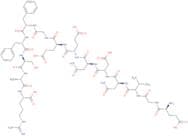
CAS 103213-49-6
:(glu1)-fibrinopeptide B
Description:
Glu1-fibrinopeptide B, identified by the CAS number 103213-49-6, is a peptide derived from fibrinogen, a key protein involved in blood coagulation. This peptide is specifically released during the conversion of fibrinogen to fibrin, a process catalyzed by the enzyme thrombin. Characteristically, Glu1-fibrinopeptide B consists of a sequence of amino acids that includes a glutamic acid at the N-terminus, which is significant for its biological activity and role in the coagulation cascade. The peptide plays a crucial role in the regulation of blood clot formation and is often used as a biomarker in clinical settings to assess thrombin activity and fibrinogen degradation. Its structure and properties are essential for understanding the dynamics of hemostasis and thrombosis. Additionally, research into fibrinopeptides like Glu1-fibrinopeptide B contributes to the development of therapeutic strategies for managing clotting disorders and cardiovascular diseases.
Formula:C66H95N19O26
InChI:InChI=1/C66H95N19O26/c1-31(2)53(85-48(90)29-73-55(100)35(67)16-19-49(91)92)64(109)83-42(26-46(69)88)61(106)82-43(27-52(97)98)62(107)81-41(25-45(68)87)60(105)78-37(18-21-51(95)96)57(102)77-36(17-20-50(93)94)56(101)74-28-47(89)76-39(23-33-11-6-4-7-12-33)58(103)80-40(24-34-13-8-5-9-14-34)59(104)84-44(30-86)63(108)75-32(3)54(99)79-38(65(110)111)15-10-22-72-66(70)71/h4-9,11-14,31-32,35-44,53,86H,10,15-30,67H2,1-3H3,(H2,68,87)(H2,69,88)(H,73,100)(H,74,101)(H,75,108)(H,76,89)(H,77,102)(H,78,105)(H,79,99)(H,80,103)(H,81,107)(H,82,106)(H,83,109)(H,84,104)(H,85,90)(H,91,92)(H,93,94)(H,95,96)(H,97,98)(H,110,111)(H4,70,71,72)
SMILES:CC(C)C(C(=NC(CC(=N)O)C(=NC(CC(=O)O)C(=NC(CC(=N)O)C(=NC(CCC(=O)O)C(=NC(CCC(=O)O)C(=NCC(=NC(Cc1ccccc1)C(=NC(Cc1ccccc1)C(=NC(CO)C(=NC(C)C(=NC(CCCNC(=N)N)C(=O)O)O)O)O)O)O)O)O)O)O)O)O)N=C(CN=C(C(CCC(=O)O)N)O)O
Synonyms:- H-Glu-Gly-Val-Asn-Asp-Asn-Glu-Glu-Gly-Phe-Phe-Ser-Ala-Arg-OH
- Glu-Gly-Val-Asn-Asp-Asn-Glu-Glu-Gly-Phe-Phe-Ser-Ala-Arg
Sort by
Purity (%)
0
100
|
0
|
50
|
90
|
95
|
100
Found 5 products.
[Glu<sup>1</sup>] Fibrinopeptide B, Human
CAS:For cellular and molecular biology applicationsFormula:C66H95N19O26Molecular weight:1570.57(Glu¹)-Fibrinopeptide B (human)
CAS:Bachem ID: 4016660.
Formula:C66H95N19O26Purity:96.3%Color and Shape:White LyophilisateMolecular weight:1570.59[Glu1]-Fibrinopeptide B
CAS:[Glu1]-Fibrinopeptide B, from human fibrinogen Bβ-chain (1-14), is created by thrombin and activates PMN, monocytes, fibroblasts.Formula:C66H95N19O26Purity:98%Color and Shape:SolidMolecular weight:1570.6[Glu1] Fibrinopeptide B, human
CAS:Custom research peptide; min purity 95%. For different specs please use the Peptide Quote Tool
Formula:C66H95N19O26Molecular weight:1,570.6 g/mol(Glu1)-Fibrinopeptide B (human)
CAS:Fibrinopeptide B (FPB) is a protein fragment of the blood clotting process. It is a member of the group of fibrinopeptides, which are formed by proteolytic cleavage of the precursor prothrombin. FPB is a low molecular weight peptide with an amino acid sequence that contains tryptophan and arginine residues, which are susceptible to oxidation by radiation. The presence of FPB in plasma can be used as an indicator for exposure to ionizing radiation. Matrix-assisted laser desorption/ionization (MALDI) mass spectrometry has been used to identify and quantify FPB in human plasma samples. This technique has also been applied to monitor the proteomic profile of activated platelets with high sensitivity using matrix molecules such as glycerol, ethylene glycol, and formamide as matrices for MALDI analysis.Formula:C66H95N19O26Purity:Min. 95%Molecular weight:1,570.57 g/mol



![[Glu1]-Fibrinopeptide B](/_next/image/?url=https%3A%2Fstatic.cymitquimica.com%2Fproducts%2FTM%2Fthumb%2FTP1864.jpg&w=3840&q=75)

![[Glu1] Fibrinopeptide B, human](/_next/image/?url=https%3A%2Fstatic.cymitquimica.com%2Fproducts%2F3D%2Fthumb%2FPP50447.jpg&w=3840&q=75)