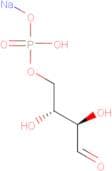
CAS 103302-15-4
:D-erythrose 4-phosphate sodium salt
Description:
D-erythrose 4-phosphate sodium salt is a phosphorylated sugar derivative, specifically a four-carbon aldose sugar, which plays a crucial role in various biochemical pathways, including the pentose phosphate pathway and nucleotide synthesis. As a sodium salt, it is typically more soluble in water compared to its free acid form, enhancing its utility in biochemical applications. The compound features a hydroxyl group (-OH) on each of its carbon atoms, contributing to its reactivity and ability to participate in enzymatic reactions. D-erythrose 4-phosphate is a key intermediate in the synthesis of nucleotides and amino acids, making it significant in metabolic processes. Its structure includes a phosphate group, which imparts a negative charge, influencing its interactions with enzymes and other biomolecules. The compound is often utilized in research and industrial applications, particularly in the fields of biochemistry and molecular biology, where it serves as a substrate or a building block for various biochemical syntheses.
Formula:C4H9O7P
Sort by
Purity (%)
0
100
|
0
|
50
|
90
|
95
|
100
Found 3 products.
D-Erythrose 4-phosphate (sodium)
CAS:D-Erythrose 4-phosphate (sodium)
Purity:98%Molecular weight:222.07g/molD-Erythrose 4-phosphate sodium
CAS:D-erythrose 4-sodium phosphate: sodium salt of monosaccharide, made from erythritol via 3 isomerases.Formula:C4H8NaO7PPurity:98%Color and Shape:SolidMolecular weight:222.07D-Erythrose 4-phosphate sodium
CAS:D-erythrose 4-phosphate sodium (D-EPPS) is a phosphoenolpyruvate analog and an inhibitor of chorismate mutase, which is an enzyme that catalyzes the conversion of D-arabinose 5-phosphate to D-erythrose 4-phosphate. It is used to study the biosynthesis of aromatic amino acids in bacteria. This compound has also been shown to inhibit phosphate uptake by Escherichia coli K12, leading to a decrease in the accumulation of ATP and other nucleotides. D-EPPS binds metal ions and organic acids such as citrate, which influences its thermodynamic stability. Biochemical techniques can be used for profiling D-EPPS in bacterial cells.Formula:C4H8NaO7PPurity:(%) Min. 50%Color and Shape:White PowderMolecular weight:222.07 g/mol