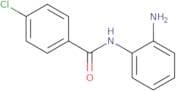
CAS 103517-58-4
:N-(2-Aminophenyl)-4-chlorobenzamide
Description:
N-(2-Aminophenyl)-4-chlorobenzamide, also known by its CAS number 103517-58-4, is an organic compound characterized by its amide functional group and the presence of both an amino group and a chlorobenzene moiety. This compound features a benzamide structure where a 4-chloro substituent is attached to one aromatic ring, while a 2-aminophenyl group is linked to the nitrogen of the amide. The presence of the amino group contributes to its potential as a ligand in coordination chemistry and may influence its biological activity, making it of interest in pharmaceutical research. The chlorobenzene component can enhance lipophilicity, affecting the compound's solubility and permeability. Additionally, the compound may exhibit various physical properties such as melting point, boiling point, and solubility in different solvents, which are essential for its application in synthesis and drug development. Overall, N-(2-Aminophenyl)-4-chlorobenzamide is a compound of interest in medicinal chemistry due to its structural features and potential biological activities.
Formula:C13H11ClN2O
InChI:InChI=1S/C13H11ClN2O/c14-10-7-5-9(6-8-10)13(17)16-12-4-2-1-3-11(12)15/h1-8H,15H2,(H,16,17)
InChI key:InChIKey=PRZZSWCUIWZUHO-UHFFFAOYSA-N
SMILES:C(NC1=C(N)C=CC=C1)(=O)C2=CC=C(Cl)C=C2
Synonyms:- 2′-Amino-4-chlorobenzanilide
- Benzamide, N-(2-aminophenyl)-4-chloro-
- N-(2-Aminophenyl)-4-chlorobenzamide
Sort by
Purity (%)
0
100
|
0
|
50
|
90
|
95
|
100
Found 1 products.
N-(2-Aminophenyl)-4-chlorobenzamide
CAS:N-(2-Aminophenyl)-4-chlorobenzamide (NPCB) is a synthetic drug that inhibits prostaglandin synthesis. It is an anti-inflammatory agent and has been shown to reduce the severity of inflammation in animal models. NPCB crystallizes with a monoclinic crystal system and can be used for crystal x-ray diffraction studies. The cell parameters are calculated by analyzing the crystal structure, which gives information about the chemical composition of the compound. X-ray diffraction techniques are used to study these structures, as well as other properties such as surface analysis.
Formula:C13H11ClN2OPurity:Min. 95%Molecular weight:246.69 g/mol