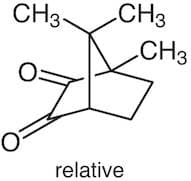
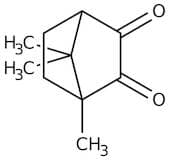
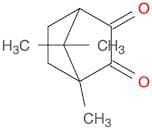
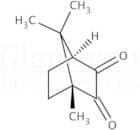
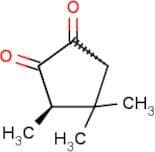
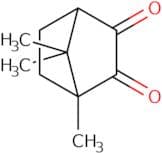
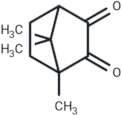
CAS 10373-78-1
:Camphorquinone
Description:
Camphorquinone, with the CAS number 10373-78-1, is an organic compound that belongs to the class of quinones. It is derived from camphor and is characterized by its yellow crystalline appearance. Camphorquinone is known for its strong absorption of ultraviolet light, making it useful as a photoinitiator in various polymerization processes, particularly in dental materials and coatings. The compound exhibits a distinct odor reminiscent of camphor, which is attributed to its structural similarity to camphor itself. Camphorquinone is soluble in organic solvents such as ethanol and acetone but has limited solubility in water. Its reactivity is primarily due to the presence of the quinone functional group, which can participate in redox reactions. Additionally, camphorquinone has been studied for its potential applications in photodynamic therapy and as a photosensitizer. Safety considerations include handling it with care, as it may cause irritation upon contact with skin or eyes. Overall, camphorquinone is a versatile compound with significant applications in both industrial and medical fields.
Formula:C10H14O2
InChI:InChI=1/C10H14O2/c1-9(2)6-4-5-10(9,3)8(12)7(6)11/h6H,4-5H2,1-3H3/t6-,10-/m1/s1
InChI key:InChIKey=VNQXSTWCDUXYEZ-UHFFFAOYSA-N
SMILES:CC12C(C)(C)C(C(=O)C1=O)CC2
Synonyms:- (.+-.)-Camphorquinone
- 1,7,7-Trimethylbicyclo[2.2.1]heptane-2,3-dione
- 2,3-Bornanedione, (.+-.)-
- <span class="text-smallcaps">DL</span>-Bornane-2,3-dione
- C 0014
- Camphoquinone
- Camphoroquinone
- Camphorquinone, Dl-
- DL-bornane-2,3-dione
- Dl-Bornano-2,3-Diona
- Nsc 285
- Nsc 402031
- dl-2,3-Camphanedione
- dl-Bornan-2,3-dion
- dl-Camphorquinone
- Bicyclo[2.2.1]heptane-2,3-dione, 1,7,7-trimethyl-
- Bicyclo[2.2.1]heptane-2,3-dione, 1,7,7-trimethyl-, (±)-
- Mixed camphorquinone
- Synthesis camphorquinone
- (1S,4S)-1,7,7-trimethylbicyclo[2.2.1]heptane-2,3-dione
- dl-Camphor quinone
- DL-CAMPHOROQUINONE
- (±)-camphandione
- RAC-CAMPHORQUINONE
- LABOTEST-BB LT00146630
- 1,7,7-TRIMETHYLNORBORNANE-2,3-DIONE
- BORNANEDIONE
- 1,7,7-TRIMETHYL-BICYCLO[2.2.1]HEPTANE-2,3-DIONE
- 3-dione,1,7,7-trimethyl-,(+-)-Bicyclo[2.2.1]heptane-2
- 7,7-trimethyl-3-dion(+/-)-bicyclo[2.2.1]heptane-1
- See more synonyms
Sort by
Purity (%)
0
100
|
0
|
50
|
90
|
95
|
100
Found 9 products.
(±)-Camphorquinone
CAS:Formula:C10H14O2Purity:>98.0%(GC)Color and Shape:Light yellow to Yellow powder to crystalMolecular weight:166.22(+/-)-Camphorquinone, 99%
CAS:Camphorquinone derivative (i.e. carboxylated camphorquinone) is used as visible-light photoinitiator in biomedical applications. It is also used in dentistry and is often used in conjunction with hydrogen donating amine. This Thermo Scientific Chemicals brand product was originally part of the AlfaFormula:C10H14O2Purity:99%Color and Shape:Yellow, Crystals or powder or crystalline powderMolecular weight:166.22DL-Camphorquinone
CAS:Formula:C10H14O2Purity:≥ 98.0%Color and Shape:Yellow crystalline powder or solidMolecular weight:166.22DL-Camphorquinone
CAS:DL-CamphorquinoneFormula:C10H14O2Purity:98%Color and Shape: biright yellow powderMolecular weight:166.22g/molCamphorquinone
CAS:Camphorquinone is an inorganic acid that is a component of the topical anaesthetic hydrochloride, which is used for the treatment of pain. Camphorquinone has a hydroxyl group, which can be replaced with other groups to produce different compounds. It has been shown to have a kinetic data for the polymerase chain reaction and to inhibit the activity of 4-dimethylaminobenzoic acid. Camphorquinone has also been shown to be effective against dental plaque and rat liver microsomes. The clinical relevance of camphorquinone has not yet been determined, but it may have an effect on hydrochloric acid production by zirconium oxide light emission.
Formula:C10H14O2Purity:Min. 95%Color and Shape:PowderMolecular weight:166.22 g/molCamphorquinone
CAS:Camphorquinone (CQ) is a widely used photoinitiator in dental materials.Formula:C10H14O2Color and Shape:SolidMolecular weight:166.22