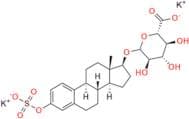
CAS 10392-35-5
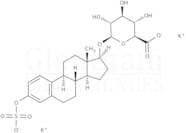
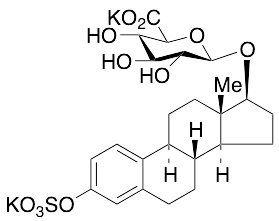
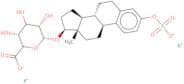
:B-estradiol 3-sulfate 17-glucuronide*dipotassium
Estradiol 3-sulfate 17b-glucuronide dipotassium salt
CAS:Formula:C24H32K2O11SPurity:≥ 97.0%Color and Shape:White solidMolecular weight:606.77Estradiol 3-sulfate 17β-Glucuronide potassium salt
CAS:Estradiol 3-sulfate 17β-Glucuronide potassium salt is a naturally occurring estrogen and can be used to study metabolic diseases.Formula:C24H30K2O11SColor and Shape:SolidMolecular weight:604.75Estradiol 3-Sulfate 17beta-Glucuronide Dipotassium
CAS:Controlled ProductApplications A 17β-Estradiol (E888000) metabolite.
References Gerk, P., et al.: Drug Metab. Disposition, 32, 1139 (2004), Antignac, J., et al.: Steroids, 70, 205 (2005), Cole, T., et al.: J. Fish Biol., 68, 661 (2006), Hutchins, S., et al.: Env. Sci. Technol., 41, 7192 (2007),Formula:C24H30O11S·2KColor and Shape:White To Off-WhiteMolecular weight:604.75Estradiol 3-sulfate 17β-glucuronide dipotassium
CAS:Estradiol 3-sulfate 17b-glucuronide dipotassium salt is an estradiol ester that is a metabolite of estradiol. It has been shown to be an intermediate in the synthesis of estrone sulfate and other steroid hormones. Estradiol 3-sulfate 17b-glucuronide dipotassium salt is formed from estradiol by the addition of one molecule of sulfuric acid followed by the addition of glucuronic acid, which results in a salt form. It may also be formed by oxidation of allylic hydroperoxides and photooxygenation in families with oxygenated moieties. Irradiation leads to formation of oxygenated steroids. The alkene reactivity depends on the substitution pattern, the cyclic reactivity depends on the ring size and substitution pattern, and the reactivity with peroxides depends on the position of substitution.
Formula:C24H32O11S•K2Purity:Min. 95%Color and Shape:White to off-white solid.Molecular weight:606.77 g/molEstradiol 3-Sulfate 17β-Glucuronide Dipotassium Salt
CAS:Formula:C24H30O11SKMolecular weight:526.55 : 2(39.10)