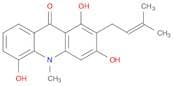
CAS 103956-34-9
:1,3,5-Trihydroxy-10-methyl-2-(3-methyl-2-buten-1-yl)-9(10H)-acridinone
Description:
1,3,5-Trihydroxy-10-methyl-2-(3-methyl-2-buten-1-yl)-9(10H)-acridinone, with the CAS number 103956-34-9, is a chemical compound that belongs to the acridinone class. This substance features a complex structure characterized by multiple hydroxyl groups, which contribute to its potential solubility and reactivity. The presence of a methyl group and a 3-methyl-2-buten-1-yl side chain indicates that it may exhibit unique steric and electronic properties, influencing its biological activity. The hydroxyl groups can participate in hydrogen bonding, enhancing interactions with biological macromolecules. This compound may possess potential applications in medicinal chemistry, particularly in the development of pharmaceuticals, due to its structural features that could interact with various biological targets. Additionally, the acridinone framework is known for its role in various biological activities, including antimicrobial and anticancer properties. However, specific data regarding its toxicity, stability, and detailed biological effects would require further investigation through experimental studies.
Formula:C19H19NO4
InChI:InChI=1S/C19H19NO4/c1-10(2)7-8-11-15(22)9-13-16(18(11)23)19(24)12-5-4-6-14(21)17(12)20(13)3/h4-7,9,21-23H,8H2,1-3H3
InChI key:InChIKey=YDKCXKMKJZNVHQ-UHFFFAOYSA-N
SMILES:O=C1C=2C(N(C)C=3C1=CC=CC3O)=CC(O)=C(CC=C(C)C)C2O
Synonyms:- 9(10H)-Acridinone, 1,3,5-trihydroxy-10-methyl-2-(3-methyl-2-buten-1-yl)-
- 9(10H)-Acridinone, 1,3,5-trihydroxy-10-methyl-2-(3-methyl-2-butenyl)-
- 1,3,5-Trihydroxy-10-methyl-2-(3-methyl-2-buten-1-yl)-9(10H)-acridinone
- Junosine
Sort by
Purity (%)
0
100
|
0
|
50
|
90
|
95
|
100
Found 2 products.
9(10H)-Acridinone, 1,3,5-trihydroxy-10-methyl-2-(3-methyl-2-buten-1-yl)-
CAS:Formula:C19H19NO4Molecular weight:325.3585Junosine
CAS:Junosine is a semi-synthetic antibiotic, which is derived from natural sources through chemical modifications. It exhibits a potent mode of action by inhibiting bacterial protein synthesis, effectively targeting the ribosomal subunits of Gram-positive bacteria. This inhibition disrupts peptide elongation, thereby curtailing bacterial growth and proliferation.Formula:C19H19NO4Purity:Min. 95%Molecular weight:325.4 g/mol