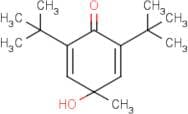
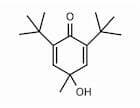
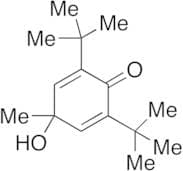
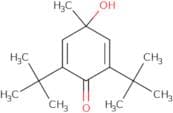
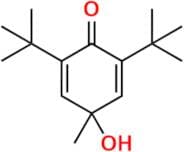
CAS 10396-80-2
:2,6-Di(tert-butyl)-4-hydroxy-4-methyl-2,5-cyclohexadien-1-one
- 2,5-Cyclohexadien-1-one, 2,6-bis(1,1-dimethylethyl)-4-hydroxy-4-methyl-
- 2,5-Cyclohexadien-1-one, 2,6-di-tert-butyl-4-hydroxy-4-methyl-
- 2,6-Bis(1,1-dimethylethyl)-4-hydroxy-4-methyl-2,5-cyclohexadien-1-one
- 2,6-Di-Tert-Butyl-4-Hydroxy-4-Methylcyclohexa-2,5-Dien-1-One
- 2,6-Di-t-butyl-4-hydroxy-4-methyl-2,5-cyclohexadienone
- 2,6-Di-tert-butyl-4-hydroxy-4-methyl-2,5-cyclohexadienone
- 2,6-Di-tert-butyl-4-methyl-4-hydroxy-2,5-cyclohexadien-1-one
- 2,6-Ditert-butyl-4-hydroxy-4-methylcyclohexa-2,5-dien-1-one
- 4-Hydroxy-4-methyl-2,6-di-tert-butyl-2,5-cyclohexadienone
- Bht-Oh
- Brn 2050856
- 2,6-Di-tert-butyl-4-hydroxy-4-methyl-2,5-cyclohexadien-1-one
- See more synonyms
2,6-Di(tert-butyl)-4-hydroxy-4-methyl-2,5-cyclohexadien-1-one
CAS:2,6-Di(tert-butyl)-4-hydroxy-4-methyl-2,5-cyclohexadien-1-oneFormula:C15H24O2Purity:98%Color and Shape: white solidMolecular weight:236.35g/mol2,6-Di(tert-butyl)-4-hydroxy-4-methyl-2,5-cyclohexadien-1-one
CAS:Formula:C15H24O2Purity:98%Molecular weight:236.352,6-Di(tert-butyl)-4-Hydroxy-4-Methyl-2,5-cyclohexadien-1-One
CAS:Formula:C15H24O2Molecular weight:236.362,6-Di(tert-butyl)-4-hydroxy-4-methyl-2,5-cyclohexadien-1-one
CAS:Applications 2,6-Di(tert-butyl)-4-hydroxy-4-methyl-2,5-cyclohexadien-1-one is a metabolite of BHT (D429480), which acts as an antioxidant.
References Bronaugh, R.L. et al.: Tox. Appl. Pharm., 99, 534 (1989);Formula:C15H24O2Color and Shape:NeatMolecular weight:236.352,6-Di(tert-butyl)-4-hydroxy-4-methyl-2,5-cyclohexadien-1-one
CAS:2,6-Di(tert-butyl)-4-hydroxy-4-methyl-2,5-cyclohexadien-1-one (BHT) is a reactive methide that can be produced by the nucleophilic attack of an electrophile on a molecule containing a methylene group. BHT is used in analytical chemistry as an antioxidant and free radical scavenger. BHT has been shown to protect rat liver microsomes from damage induced by oxidative stress and to inhibit the development of lung cancer in rats chronically treated with cigarette smoke. This product also has been used in modelling studies to study the effect of alveolar type II cells on airway hyperresponsiveness.
Formula:C15H24O2Purity:Min. 95%Color and Shape:PowderMolecular weight:236.35 g/mol2,6-Di-tert-butyl-4-hydroxy-4-methylcyclohexa-2,5-dien-1-one
CAS:Purity:98%Color and Shape:SolidMolecular weight:236.3549957