CAS 104-10-9
:2-(4-Aminophenyl)ethanol
Description:
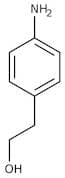
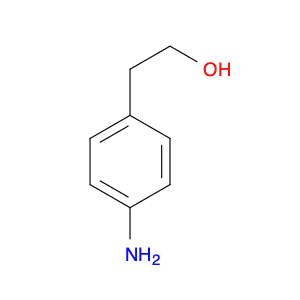
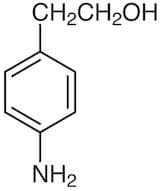
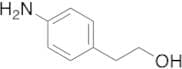
2-(4-Aminophenyl)ethanol, also known as para-aminophenylethanol, is an organic compound characterized by the presence of both an amino group (-NH2) and a hydroxyl group (-OH) attached to a phenyl ring. This compound features a two-carbon ethyl chain linking the amino-substituted phenyl group to the hydroxyl group. It is typically a white to off-white solid at room temperature and is soluble in water and organic solvents due to its polar functional groups. The presence of the amino group imparts basic properties, allowing it to participate in various chemical reactions, including acylation and alkylation. 2-(4-Aminophenyl)ethanol is of interest in medicinal chemistry and may serve as a precursor in the synthesis of pharmaceuticals, particularly in the development of analgesics and anti-inflammatory agents. Additionally, it can be used in dye manufacturing and as a reagent in organic synthesis. Safety precautions should be observed when handling this compound, as it may pose health risks upon exposure.
Formula:C8H11NO
InChI:InChI=1S/C8H11NO/c9-8-3-1-7(2-4-8)5-6-10/h1-4,10H,5-6,9H2
InChI key:InChIKey=QXHDYMUPPXAMPQ-UHFFFAOYSA-N
SMILES:C(CO)C1=CC=C(N)C=C1
Synonyms:- 2-(4-Amino-phenyl)ethanol
- 2-(4-Aminophenyl) ethanol
- 2-(4-Aminophenyl)-1-ethanol
- 2-(4-Aminophenyl)ethyl alcohol
- 2-(p-Aminophenyl)ethanol
- 4-(2-Hydroxyethyl)aniline
- 4-(2-Hydroxyethyl)phenylamine
- 4-Amino Phenethyl Alcohol
- 4-Aminobenzeneethanol
- 4-Aminophenethyl alcohol
- Benzeneethanol, 4-amino-
- NSC 409780
- P-Amino Phenethyl Alcohol
- P-Aminophenethyl Alcohol
- Phenethyl alcohol, p-amino-
- See more synonyms
Sort by
Purity (%)
0
100
|
0
|
50
|
90
|
95
|
100
Found 10 products.
2-(4-Aminophenyl)ethanol, 97%
CAS:2-(4-Aminophenyl)ethanol is used as nonsymmetric monomer in the preparation of ordered [head-to-head (H-H) or tail-to-tail (T-T)] poly(amide-ester), in the synthesis of 4-aminostyrene and in functionalization of graphene nanoplatelets. This Thermo Scientific Chemicals brand product was originallyFormula:C8H11NOPurity:97%Color and Shape:Pale cream to cream to yellow to brown, Crystals or powder or crystalline powder or lumps or granulesMolecular weight:137.184-Aminophenethyl alcohol
CAS:4-Aminophenethyl alcoholFormula:C8H11NOPurity:≥95%Color and Shape: brown crystalline powderMolecular weight:137.17903g/mol2-(4-Aminophenyl)ethanol
CAS:Formula:C8H11NOPurity:>98.0%(GC)(T)Color and Shape:White to Light yellow to Light orange powder to crystalMolecular weight:137.184-Aminophenethyl alcohol
CAS:Formula:C8H11NOPurity:95%Color and Shape:Solid, Chunks or Crystalline PowderMolecular weight:137.1824-Aminophenethyl Alcohol
CAS:Controlled ProductApplications 4-Aminophenethyl Alcohol, is a building block that can be used in the synthesis of various compounds, such as in synthesis of 4-aminostyrene, and in functionalization of graphene nanoplatelets.
References Li L, et al.Polymer Journal 33(4), 364-370; Hagiwara T, et al. Macromolecules 24(26), 6856-6858, (1991);Formula:C8H11NOColor and Shape:NeatMolecular weight:137.184-Aminophenethyl alcohol
CAS:4-Aminophenethyl alcohol is a monosubstituted, basic compound that is used in the laboratory as a cell culture medium supplement to promote growth of fibroblasts. This compound has been shown to stimulate human intestinal cells and human peripheral blood mononuclear cells. 4-Aminophenethyl alcohol acts as a hydroxyl group donor, which may be due to its ability to form hydrogen ions when reacted with sodium hydroxide solution. The reaction of this compound with diazonium salt produces an intermediate, which can be hydrolyzed by the addition of sodium hydroxide solution. The resultant chloride ion reacts with the aminophenethyldihydroxylamine (APDA) moiety to produce APDCl. This product has been shown to increase the population growth rate of fibroblasts in culture by causing DNA synthesis and protein synthesis. Linear regression analysis revealed that there was no statistically significant difference between the control and experimental groups for either DNAFormula:C8H11NOPurity:Min. 95%Molecular weight:137.18 g/mol