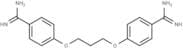
CAS 104-32-5
:propamidine
- 4,4'-[Propane-1,3-Diylbis(Oxy)]Dibenzenecarboximidamide
- 4,4-Trimethylenedioxydibenzamidine
- 4,4′-(Trimethylenedioxy)dibenzamidine
- 4,4′-[1,3-Propanediylbis(oxy)]bis[benzenecarboximidamide]
- Benzamidine, 4,4′-(trimethylenedioxy)di-
- Benzenecarboximidamide, 4,4′-[1,3-propanediylbis(oxy)]bis-
- M. & B. 782
- Panamidin
- p,p′-(Trimethylenedioxy)dibenzamidine
- Propamidine
- 4,4'-[1,3-Propanediylbis(oxy)]bis(benzenecarbimidamide)
- 4,4'-(1,3-Propanediylbis(oxy))bisbenzenecarboximidamide
- DAPP
- 4,4'-(1,3-Propanediyl)bis(oxy)bisbenzamidine
- 4,4'-[1,3-Propanediylbis(oxy)]dibenzenecarboximidamide
- See more synonyms
Propamidine
CAS:Propamidine is a drug that is used to treat amoebiasis. It is also used to kill trophozoites and prevent the disease activity in patients with amoebiasis. Propamidine has been shown to have a synergistic effect when administered with sodium succinate and benzalkonium chloride. Propamidine has been reported as being effective against resistant mutants of Entamoeba histolytica, but not against other types of parasitic protozoa or bacteria. Propamidine has been shown to be an effective chemotherapy agent for the treatment of infectious diseases such as malaria, toxoplasmosis, and leishmaniasis, which are caused by protozoa. This drug inhibits the growth of bacteria by binding to dna duplexes and preventing them from separating during replication. Propamidine also prevents the synthesis of proteins by inhibiting protein synthesis in bacterial cells.
Formula:C17H20N4O2Purity:Min. 75%Color and Shape:Off-White Yellow PowderMolecular weight:312.37 g/molPropamidine
CAS:Propamidine acts as a covalent inhibitor of TMPRSS2 and exhibits antibacterial properties. [1]Formula:C17H20N4O2Purity:98%Color and Shape:SolidMolecular weight:312.37