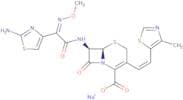
![5-Thia-1-azabicyclo[4.2.0]oct-2-ene-2-carboxylic acid, 7-[[(2Z)-2-(2-amino-4-thiazolyl)-2-(methoxy…](/_next/image/?url=https%3A%2Fstatic.cymitquimica.com%2Fcas-image%2Fthumb-webp%2F313410-5-thia-1-azabicyclo-4-2-0-oct-2-ene-2-carboxylic-acid-7-2z-2-2-amino-4-thiazolyl-2-methoxyimino-acetyl-amino-3-1z-2-4-methyl-5-thiazolyl-ethenyl-8-oxo-sodium-salt-1-1-6r-7r.webp&w=3840&q=75)
CAS 104146-53-4
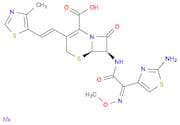
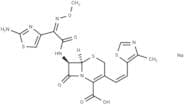
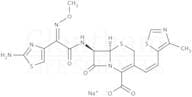
:5-Thia-1-azabicyclo[4.2.0]oct-2-ene-2-carboxylic acid, 7-[[(2Z)-2-(2-amino-4-thiazolyl)-2-(methoxyimino)acetyl]amino]-3-[(1Z)-2-(4-methyl-5-thiazolyl)ethenyl]-8-oxo-, sodium salt (1:1), (6R,7R)-
Description:
5-Thia-1-azabicyclo[4.2.0]oct-2-ene-2-carboxylic acid, 7-[[(2Z)-2-(2-amino-4-thiazolyl)-2-(methoxyimino)acetyl]amino]-3-[(1Z)-2-(4-methyl-5-thiazolyl)ethenyl]-8-oxo-, sodium salt (1:1), (6R,7R)- is a complex chemical compound characterized by its bicyclic structure, which includes both thiazole and thiazolidine moieties. This compound is notable for its potential pharmacological applications, particularly as an antibiotic, due to its structural similarity to other known antimicrobial agents. The presence of multiple functional groups, including carboxylic acid and amine functionalities, contributes to its reactivity and solubility in aqueous environments. The sodium salt form enhances its stability and bioavailability. Its stereochemistry, indicated by the (6R,7R) configuration, is crucial for its biological activity, influencing how it interacts with target enzymes or receptors. Overall, this compound exemplifies the intricate relationship between molecular structure and biological function, making it a subject of interest in medicinal chemistry and drug development.
Formula:C19H18N6O5S3·Na
InChI:InChI=1S/C19H18N6O5S3.Na/c1-8-11(33-7-21-8)4-3-9-5-31-17-13(16(27)25(17)14(9)18(28)29)23-15(26)12(24-30-2)10-6-32-19(20)22-10;/h3-4,6-7,13,17H,5H2,1-2H3,(H2,20,22)(H,23,26)(H,28,29);/b4-3-,24-12-;/t13-,17-;/m1./s1
InChI key:InChIKey=YZHABJAZXAOLGE-WSWQWPGSSA-N
SMILES:C(O)(=O)C=1N2[C@@]([C@H](NC(/C(=N\OC)/C3=CSC(N)=N3)=O)C2=O)(SCC1/C=C\C4=C(C)N=CS4)[H].[Na]
Synonyms:- 5-Thia-1-azabicyclo(4.2.0)oct-2-ene-2-carboxylic acid, 7-(((2-amino-4-thiazolyl)(methoxyimino)acetyl)amino)-3-(2-(4-methyl-5-thiazolyl)ethenyl)-8-oxo-, monosodium salt, (6R-(3(Z),6-alpha,7-beta(Z)))-
- 5-Thia-1-azabicyclo[4.2.0]oct-2-ene-2-carboxylic acid, 7-[[(2-amino-4-thiazolyl)(methoxyimino)acetyl]amino]-3-[2-(4-methyl-5-thiazolyl)ethenyl]-8-oxo-, monosodium salt, [6R-[3(Z),6α,7β(Z)]]-
- 5-Thia-1-azabicyclo[4.2.0]oct-2-ene-2-carboxylic acid, 7-[[(2Z)-(2-amino-4-thiazolyl)(methoxyimino)acetyl]amino]-3-[(1Z)-2-(4-methyl-5-thiazolyl)ethenyl]-8-oxo-, monosodium salt, (6R,7R)-
- 5-Thia-1-azabicyclo[4.2.0]oct-2-ene-2-carboxylic acid, 7-[[(2Z)-2-(2-amino-4-thiazolyl)-2-(methoxyimino)acetyl]amino]-3-[(1Z)-2-(4-methyl-5-thiazolyl)ethenyl]-8-oxo-, sodium salt (1:1), (6R,7R)-
- 5-thia-1-azabicyclo[4.2.0]oct-2-ene-2-carboxylic acid, 7-[[(2E)-2-(2-amino-4-thiazolyl)-2-(methoxyimino)-1-oxoethyl]amino]-3-[(E)-2-(4-methyl-5-thiazolyl)ethenyl]-8-oxo-, sodium salt, (6R,7R)- (1:1)
- Cefditoren sodium
- Me 1206
Sort by
Purity (%)
0
100
|
0
|
50
|
90
|
95
|
100
Found 5 products.
Cefditoren Sodium Salt
CAS:Formula:C19H17N6O5S3·NaColor and Shape:Yellow SolidMolecular weight:505.56 22.99Cefditoren sodium
CAS:Cefditoren sodium: cephalosporin antibiotic for bacterial infections; alters Mrp2, Bcrp, Oat2, P-gp, Oct1 mRNA levels.Formula:C19H18N6NaO5S3Color and Shape:SolidMolecular weight:529.57Cefditoren acid sodium
CAS:Cefditoren acid sodium is an antibacterial agent that belongs to the class of third-generation cephalosporins, which is derived from Acremonium fungus and produced through chemical synthesis. This compound acts by inhibiting bacterial cell wall synthesis, leading to cell lysis and death. It achieves this by binding to specific penicillin-binding proteins (PBPs) located inside the bacterial cell wall. The interruption of peptidoglycan synthesis in the cell wall is crucial for maintaining bacterial cell integrity, and its inhibition results in the bactericidal activity of cefditoren acid sodium. It is effective against a range of Gram-positive and Gram-negative bacteria. The key applications of this compound include the treatment of bacterial infections such as respiratory tract infections, skin infections, and other conditions caused by susceptible bacteria. Its spectrum of activity and pharmacokinetic properties make it suitable for situations where third-generation cephalosporins are indicated. Understanding the specific interaction with PBPs and the resistance mechanisms is crucial for optimizing its clinical use and managing antibiotic resistance.Formula:C19H17N6NaO5S3Purity:94%MinMolecular weight:528.56 g/mol