CAS 104408-23-3
:(3,5-dichloro-pyridin-2-yl)-hydrazine
Description:
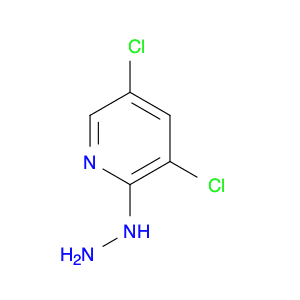
(3,5-Dichloro-pyridin-2-yl)-hydrazine is an organic compound characterized by its hydrazine functional group attached to a pyridine ring that is substituted with two chlorine atoms at the 3 and 5 positions. This compound typically appears as a solid or liquid, depending on its specific form and purity. It is known for its potential applications in pharmaceuticals and agrochemicals, often serving as an intermediate in the synthesis of various biologically active molecules. The presence of chlorine atoms enhances its reactivity and may influence its biological activity. As a hydrazine derivative, it may exhibit properties such as being a reducing agent and having potential applications in the field of medicinal chemistry. Safety considerations are important, as hydrazines can be toxic and potentially carcinogenic, necessitating careful handling and storage. Overall, (3,5-dichloro-pyridin-2-yl)-hydrazine is a compound of interest in chemical research, particularly in the development of new therapeutic agents.
- 3,5-Dichloro-2-Hydrazinylpyridine
Sort by
Purity (%)
0
100
|
0
|
50
|
90
|
95
|
100
Found 4 products.
3,5-Dichloro-2-hydrazinylpyridine
CAS:Formula:C5H5Cl2N3Purity:%Color and Shape:SolidMolecular weight:178.01933,5-Dichloro-2-hydrazinylpyridine
CAS:3,5-Dichloro-2-hydrazinylpyridinePurity:95%Molecular weight:178.02g/mol3,5-dichloro-2-hydrazinylpyridine
CAS:3,5-Dichloro-2-hydrazinylpyridine is a pyridine derivative that is synthesized by the condensation of pyrazoles with β-unsaturated carbonyl compounds. It is also used as an intermediate for the synthesis of pyrazole derivatives. The compound can be prepared by reacting acetoacetic esters and hydrazine. 3,5-Dichloro-2-hydrazinylpyridine has been shown to interact with pyrazoles, which are intermediates in its synthesis. Pyrazoles are also produced when 3,5-dichloro-2-hydrazinylpyridine reacts with β-unsaturated carbonyl compounds.
Formula:C5H5Cl2N3Purity:Min. 95%Molecular weight:178.02 g/mol