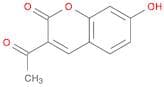
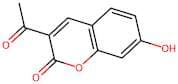
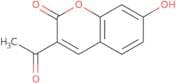
CAS 10441-27-7
:3-Acetyl-7-hydroxy-2H-1-benzopyran-2-one
Description:
3-Acetyl-7-hydroxy-2H-1-benzopyran-2-one, also known as coumarin derivative, is a chemical compound characterized by its benzopyran structure, which features a fused benzene and pyran ring. This compound typically exhibits a pale yellow to light brown appearance and is soluble in organic solvents such as ethanol and acetone, but has limited solubility in water. It possesses a distinctive aromatic odor and is known for its potential biological activities, including antioxidant, anti-inflammatory, and antimicrobial properties. The presence of the acetyl and hydroxy functional groups contributes to its reactivity and interaction with various biological systems. Additionally, this compound may be used in the synthesis of other organic compounds and has applications in the fragrance and flavor industries due to its pleasant scent. As with many coumarin derivatives, it is important to handle this substance with care, as it may have regulatory restrictions in certain applications due to potential toxicity or allergenic effects.
Formula:C11H8O4
InChI:InChI=1S/C11H8O4/c1-6(12)9-4-7-2-3-8(13)5-10(7)15-11(9)14/h2-5,13H,1H3
InChI key:InChIKey=BRQZHMHHZLRXOO-UHFFFAOYSA-N
SMILES:O=C1OC=2C(C=C1C(C)=O)=CC=C(O)C2
Synonyms:- 2H-1-Benzopyran-2-one, 3-acetyl-7-hydroxy-
- 3-Acethyl-umbelliferone
- 3-Acetyl-7-Hydroxy-Chromen-2-One
- 3-Acetyl-7-Hydroxycoumarin
- 3-Acetyl-7-hydroxy-2H-1-benzopyran-2-one
- 3-Acetyl-7-hydroxy-chromen-2-one ,98%
- 3-Acetyl-7-hydroxychromen-2-one
- 3-Acetyl-Umbelliferone
- 3-Acetyl-Umbelliferone, For Fluorescence
- 3-Acetylumbelliferone
- 7-Hydroxy-3-acetylcoumarin
- Coumarin, 3-acetyl-7-hydroxy-
- See more synonyms
Sort by
Purity (%)
0
100
|
0
|
50
|
90
|
95
|
100
Found 4 products.
3-Acetyl-7-hydroxy-2H-chromen-2-one
CAS:Formula:C11H8O4Purity:95%Color and Shape:SolidMolecular weight:204.17883-Acetyl-7-hydroxy-2H-chromen-2-one
CAS:3-Acetyl-7-hydroxy-2H-chromen-2-onePurity:95%Molecular weight:204.18g/mol3-Acetyl-7-hydroxycoumarin
CAS:3-Acetyl-7-hydroxycoumarin is a luminescent probe that can be used to detect the presence of avian influenza. It has been shown to react with acidic pH in the environment, and fluoresces in acidic environments. Coumarin derivatives are used for the detection of copper ions, which are found in many chemical reactions. The synthesis of 3-acetyl-7-hydroxycoumarin requires the use of chalcones, which are aromatic compounds that have an electron withdrawing group on their aromatic ring. This probe was shown to inhibit tumor growth and induce apoptosis in cancer cells, as well as inhibiting tumour growth by inhibiting angiogenesis.Formula:C11H8O4Purity:Min. 95%Molecular weight:204.18 g/mol