CAS 10442-39-4
:tetrabutylammonium cyanide
Description:
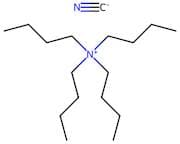
Tetrabutylammonium cyanide (TBAC) is a quaternary ammonium salt characterized by its tetrabutylammonium cation and cyanide anion. It is typically a white to off-white solid that is soluble in polar organic solvents, such as acetone and ethanol, but has limited solubility in water. TBAC is known for its use as a phase transfer catalyst in organic synthesis, facilitating the transfer of ions across phase boundaries, which enhances reaction rates and yields. The compound is also utilized in various chemical reactions, including nucleophilic substitutions and the synthesis of other organic compounds. Due to the presence of the cyanide ion, TBAC is considered toxic and poses significant health risks if ingested or inhaled, necessitating careful handling and appropriate safety measures. Its stability under standard conditions makes it a useful reagent in laboratory settings, but precautions should be taken to avoid exposure to its toxic components. Overall, tetrabutylammonium cyanide is a valuable compound in synthetic organic chemistry, albeit with inherent hazards associated with cyanide.
Formula:C17H36N2
InChI:InChI=1/C16H36N.CN/c1-5-9-13-17(14-10-6-2,15-11-7-3)16-12-8-4;1-2/h5-16H2,1-4H3;/q+1;-1
InChI key:InChIKey=KRRBFUJMQBDDPR-UHFFFAOYSA-N
SMILES:[N+](CCCC)(CCCC)(CCCC)CCCC.[C-]#N
Synonyms:- Ammonium, tetrabutyl-, cyanide
- Tetrabutylammonium cyanide
- 1-Butanaminium, N,N,N-tributyl-, cyanide
- 1-Butanaminium, N,N,N-tributyl-, cyanide (1:1)
- TetrabutylaMMoniuM cyanide 95%
- n,n,n-tributyl-1-butanaminiucyanide
- TETRABUTYLAMMONIUM CYANIDE ISO 9001:2015 REACH
- Tetrabutylaminium·cyanide
- N,N,N-Tributyl-1-butanaminium cyanide (1:1)
- tetrabutylazanium:cyanide
- Tetrabutylammonium cyanide technical, >=80%
Sort by
Purity (%)
0
100
|
0
|
50
|
90
|
95
|
100
Found 4 products.
Tetrabutylammonium cyanide
CAS:Applications Tetrabutylammonium cyanide is commonly used as a catalyst for the synthesis of organic compounds such as multisubstituted dihydrofurans and pyrrolo[2,1-a]isoquinolines.
References Liu, W., et al.: J. Org. Chem., 82, 4829-39 (2017); Du, S.T., et al.: Org. Lett., 19, 6598-01 (2017);Formula:C16H36N•CNColor and Shape:NeatMolecular weight:268.48Tetrabutylammonium cyanide
CAS:Formula:C17H36N2Purity:95.0%Color and Shape:Solid, Powder or Crystalline Powder or Solid or ChunksMolecular weight:268.489Tetrabutylammonium cyanide
CAS:Controlled ProductTetrabutylammonium cyanide is a sodium salt that has been shown to have x-ray crystal structures. It is used as a reagent in organic synthesis and as a catalyst in electrochemical reactions. The compound has been shown to react with chloride ions, transferring the electron from the carbon atom of the tetrabutylammonium to the chloride ion. This reaction mechanism can be seen with copper chloride as well. Tetrabutylammonium cyanide is also able to form an adduct with benzalkonium chloride, which can be observed through its nitrogen atoms. The hydrophobic effect may also be present in this compound, due to its large number of hydrophobic carbon chains.Formula:C17H36N2Purity:Min. 95%Molecular weight:268.48 g/mol