CAS 10489-46-0
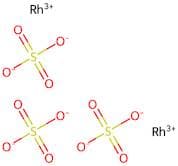
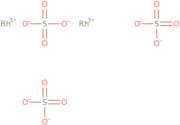
:Sulfuric acid, rhodium(3+) salt (3:2)
Description:
Sulfuric acid, rhodium(3+) salt (3:2), with the CAS number 10489-46-0, is a coordination compound that features rhodium in its +3 oxidation state complexed with sulfate ions derived from sulfuric acid. This compound typically appears as a crystalline solid and is characterized by its high solubility in water, which allows it to dissociate into its constituent ions in solution. The presence of rhodium, a transition metal, imparts unique catalytic properties, making this compound of interest in various chemical reactions, particularly in organic synthesis and catalysis. The rhodium ion can participate in redox reactions, and its coordination with sulfate can influence the stability and reactivity of the complex. Additionally, the compound may exhibit specific optical and electronic properties due to the d-orbitals of rhodium. Handling this substance requires caution, as it can be corrosive and toxic, necessitating appropriate safety measures in laboratory settings. Overall, its unique characteristics make it valuable in both industrial and research applications.
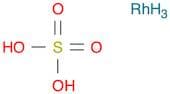
Formula:H2O4SRh
InChI:InChI=1S/H2O4S.Rh/c1-5(2,3)4;/h(H2,1,2,3,4);
InChI key:InChIKey=NZVSOIFAVIORHD-UHFFFAOYSA-N
SMILES:S(=O)(=O)(O)O.[Rh]
Synonyms:- Dirhodium trisulfate
- Rhodex
- Rhodium (III) sulphate
- Rhodium salfate
- Rhodium sulfate
- Rhodium sulfate (Rh<sub>2</sub>(SO<sub>4</sub>)<sub>3</sub>)
- Rhodium(3+) Sulfate (2:3)
- Sulfuric acid, rhodium(3+) salt (3:2)
- Rhodium sulfate (Rh2(SO4)3)
Sort by
Purity (%)
0
100
|
0
|
50
|
90
|
95
|
100
Found 4 products.
Rhodium(III) sulfate solution
CAS:Formula:Rh2(SO4)3Color and Shape:Brown to dark brown liquidMolecular weight:494.00Rhodium(III) sulfate aqueous solution, 5% Rhodium content
CAS:Rhodium(III) sulfate solution is a chemical reagent that belongs to the group of catalysts. It is used as an oxidation catalyst for organic reactions and as a reducing agent in metal surface analysis. Rhodium(III) sulfate solution has been shown to be reactive with hydroxyl groups, carbonyl groups, and nitro-containing compounds. The particle size is between 2-5 micrometers and it can be used in powder diffraction analysis as well as solid catalysis. Rhodium(III) sulfate solution reacts with chloride ions to form rhodium chloride, which precipitates out of solution. It also reacts with boron nitride to form rhodium boride, which can be separated by filtration or centrifugation.Formula:Rh2•(H2SO4)3Color and Shape:Clear LiquidMolecular weight:500.05 g/mol