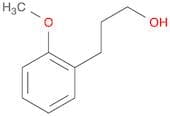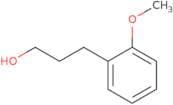
CAS 10493-37-5
:3-(2-METHOXY-PHENYL)-PROPAN-1-OL
Description:
3-(2-Methoxy-phenyl)-propan-1-ol, with the CAS number 10493-37-5, is an organic compound characterized by its structure, which includes a propanol backbone substituted with a methoxy group and a phenyl ring. This compound typically exhibits properties associated with alcohols, such as being a polar molecule due to the hydroxyl (-OH) group, which can engage in hydrogen bonding. The presence of the methoxy group enhances its solubility in organic solvents while also influencing its reactivity. It may be used in various applications, including as an intermediate in organic synthesis or in the formulation of pharmaceuticals and fragrances. The compound's physical properties, such as boiling point and melting point, would be influenced by its molecular weight and functional groups. Additionally, its behavior in chemical reactions can be affected by the steric and electronic effects of the methoxy and phenyl substituents. Safety data should be consulted for handling and storage, as with any chemical substance.
Formula:C10H14O2
InChI:InChI=1/C10H14O2/c1-12-10-7-3-2-5-9(10)6-4-8-11/h2-3,5,7,11H,4,6,8H2,1H3
SMILES:COc1ccccc1CCCO
Synonyms:- Nsc105519
Sort by
Purity (%)
0
100
|
0
|
50
|
90
|
95
|
100
Found 4 products.
3-(2-Methoxyphenyl)propan-1-ol
CAS:Formula:C10H14O2Purity:95%Color and Shape:LiquidMolecular weight:166.21703-(2-Methoxyphenyl)propan-1-ol
CAS:3-(2-Methoxyphenyl)propan-1-olPurity:95%Molecular weight:166.22g/mol3-(2-Methoxyphenyl)propan-1-ol
CAS:Formula:C10H14O2Purity:95%Color and Shape:SolidMolecular weight:166.223-(2-methoxy-phenyl)-propan-1-ol
CAS:3-(2-methoxy-phenyl)-propan-1-ol is a phenylpropanoid glycoside that has been shown to have diagnostic potential for the detection of a number of diseases. The reaction rate of 3-(2-methoxy-phenyl)-propan-1-ol can be determined by integrating the intensity of the signal from an electron spectrometer. This compound can also be used as a marker in the diagnosis of diseases such as melanogenesis, where it is found in higher concentrations than normal in the skin and other tissues. It is insoluble in water and emits fluorescence when exposed to ultraviolet light, which makes it useful for diagnostic purposes.
Formula:C10H14O2Purity:Min. 95%Molecular weight:166.22 g/mol